2007. december 28., péntek

halo search engine

Google has created a new service, "Custom Search Engine". I used this service to create a "Halo search" - search on all good sites dedicated to halo phenomena. This service can be used on any webpage (simple script), or on the home search page.

For example, when I try to search Minnaert's cigar in Halo Seach - I get 3 links, then try to search in a google "Minnaert's cigar" - 4 link, then in google, but Minnaert's cigar (without "") - 341.

You are welcome to use and improve it.

2007. december 24., hétfő

Crystal Swarm Effects


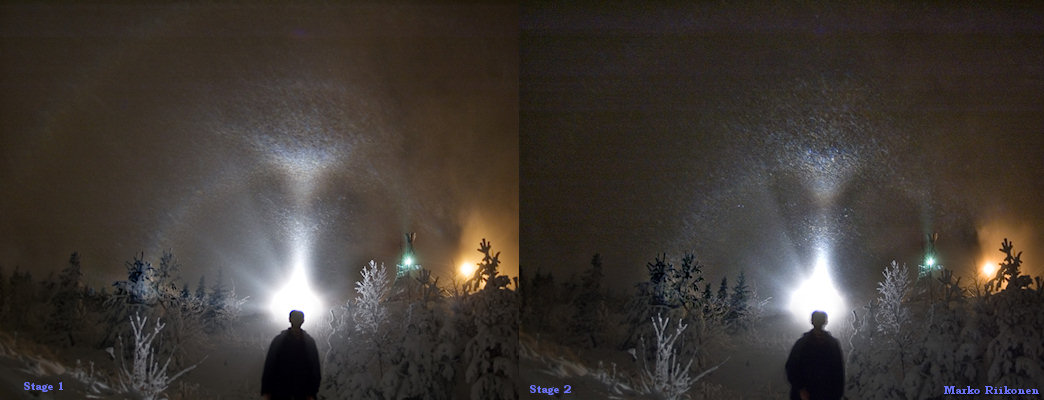
Divergent light halos can exhibit peculiar effects that are attributable to a homogenous or nonhomogenous crystal swarm. Here we present two such effects, where different parts of the "Minnaert cigar" are present in halos.

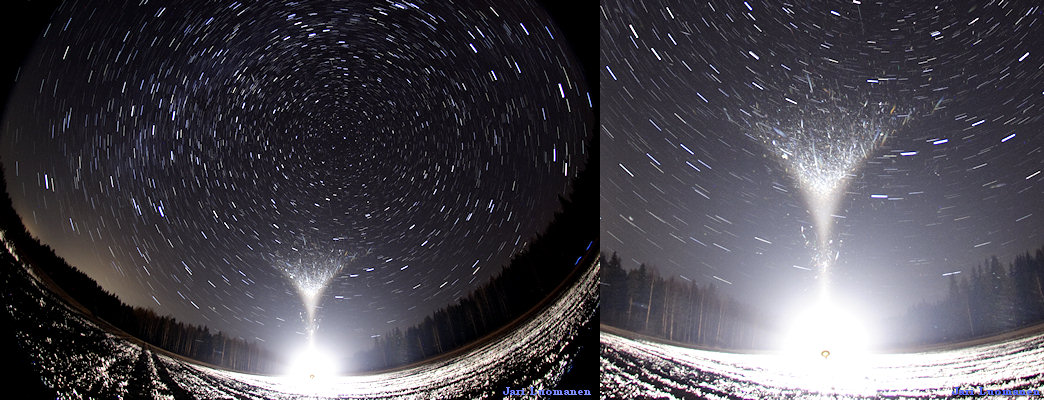
Image 1 displays a strong upper tangent arc (the whole frame and a crop is provided). It consists of two distinct parts: the upper part formed in bright separate glints and the lower more diffuse part. The diffuse part of the arc is formed in crystals further away from the camera, narrowing along the Minnaert cigar towards the lamp. The upper part is formed in crystals closer to the camera.

It is perhaps worth pointing out that the Moilanen arc is visible only in separate glints. This suggests that in this display it only formed in crystals closer to the camera, hit by relatively non-divergent rays.

The crystal swarm was homogenous as it had already travelled few kilometres from the snow guns. Total exposure time for the image 1 is 630 seconds.

Image 2 presents two photos of different stages of a display. During stage 1 the halos look familiar: 22° halo, upper tangent arc and Parry arc among others are present. During stage 2, however, some curious changes have occurred. It looks like the tangent arc has shifted towards the lamp. Also, less clearly, there is a section of an additional circular halo on the left, apparently having the same radius as the shifted tangent arc.

The effects observed during stage 2 must be caused by inhomogeneity of the crystal cloud between the observer and the lamp (the snow guns were right next to the point of observation). The crystal swarm was more concentrated close to the lamp causing the shift of the tangent arc and 22° halo along the Minnaert cigar. This is supported also by the weakening of these halos at their normal radii, formed in close by separate crystals (compare to stage 1). An animated gif is provided for an easy comparison.

These shifted halos represent a vertical cross section of the Minnaert cigar close to the lamp. Horizontal cross section of 22° halo has been documented on snow surface, as shown by these photographs: surface halo 1, surface halo 2.

Marko Riikonen & Jari Luomanen

2007. december 16., vasárnap

Diamond dust shocks in Hyvinkää, Finland


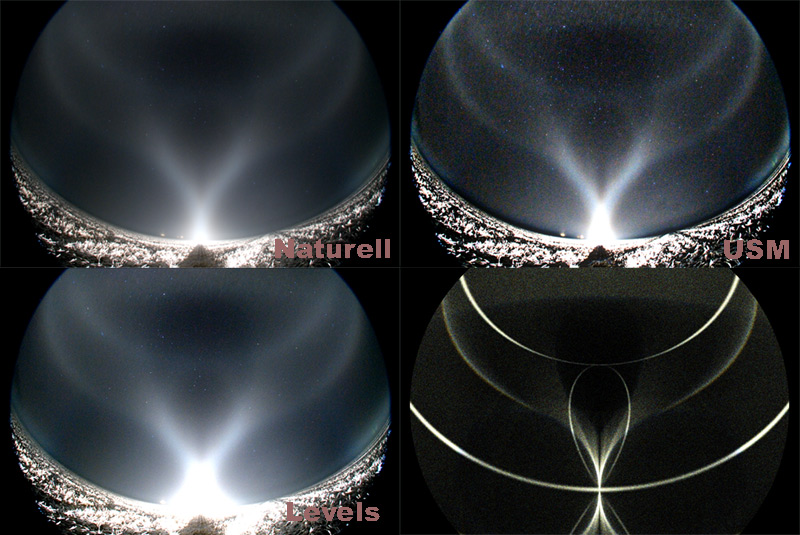
On the evening of 13th December the temperature was dropping fast and moisture level was above 95%. It was time to go. And what an evening it turned out to be! Very good crystal material created amazing halos in the beam of a portable light or car headlight. A crystal swarm lasted typically less than 15-30 minutes at a given location and then the search for another good spot started. Later in the night I was able to enjoy a display for maybe an hour at a completely dark field. During that time I had time to lay on my back (while the camera exposure was ongoing) and absorb the amazing sight.

There are several interesting features in the photos (blue spot, the "dark loop" on top of diffuse arcs etc.). On the attached photo there is a rough draft simulation illustrating the different intensity effects. Obviously fine tuning has to be done. More photos and some text can be found here. A more detailed description will follow after I have had time to concentrate on the photos and simulations.

2007. december 15., szombat

Home Made Halo


During the past year and a half I have tried to figure out how to build a Snowgun. Or, rather, an ice crystal gun since snow is not needed for creating halos. Hence, the objective has been to construct a "halo gun".

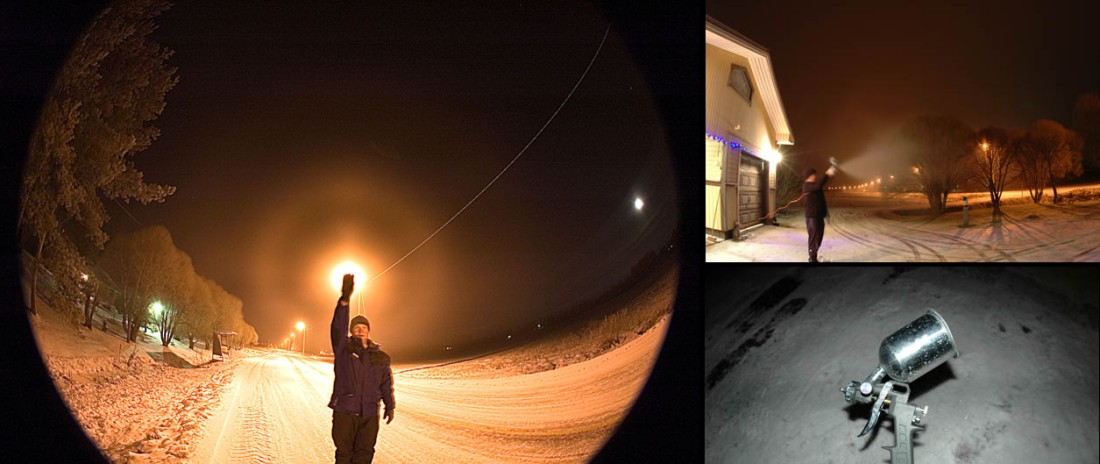
After some unsuccesful experimenting I came up with an idea of mixing small amounts of kaoline with water and spraying the solution into air. Kaoline is low cost material mainly used in ceramic industry. The halo gun itself is a simple device: all is needed is an air compressor and a paint spray gun.

On 28 November the weather finally allowed for testing the device. When sprayed into air the solution immediately transformed into ice crystals. I followed the crystal swarm to a nearby road to see whether it created any halos. It certainly did. After the second spraying the halos got even better. I observed both 22 and 46 degree halo, CZA, UTA, M-arc, parhelia, and parhelic circle. The above photograph was captured during the peak of one halo gun generated display.

The halo gun even worked with hot water which prevented the nozzle from freezing. Without Kaoline I was not able to produce ice crystals, regardless of the temperature of the water. Clearly, kaoline plays a huge part in the nucleation process.

Thus far the highest temperature where I have successfully created haloes using this method has been as high as -2 degrees celsius. This ice nucleation temperature is significantly higher than what is cited for Kaolin in various sources in literature. Similar high-temperature ice nucleation characteristic is known for Pseudomonas syringae bacterial protein, which is commonly used to intensify snow production in snow guns.

In January we will go with a small group of people to Kilpisjarvi biological station in the northhernmost Finland to experiment more thoroughly with halo making.

2007. december 10., hétfő

Divergent light effect around power cables

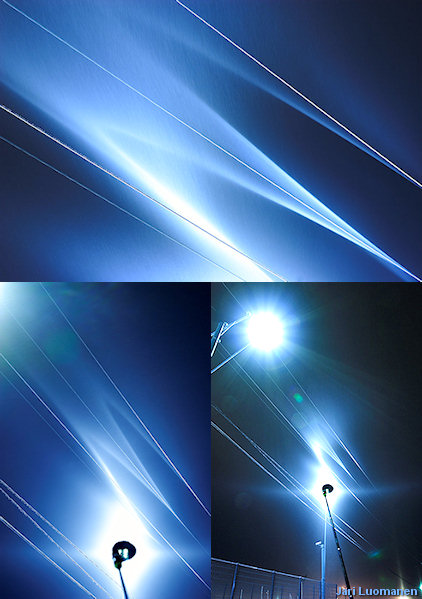
This divergent light effect was observed around power cables that reflected light from a bright lamp. The lamp was positioned behind and above the cables. The bulb of the floodlight can be seen through the dark filter.

The photographs were shot between 1 and 2 am, 29 November 2007 in Tampere, Finland. At the time of the observation the ambient temperature was -4 - -3 degrees Celsius.

The cables’ surface appears to reflect light very well. The effect was visible from a rather narrow sector only. As the observer moved sideways, the effect disappeared. At the peak of its intensity, when the telephoto shot was taken, it was very bright. The effect was clearly defined as is shown in the photographs.

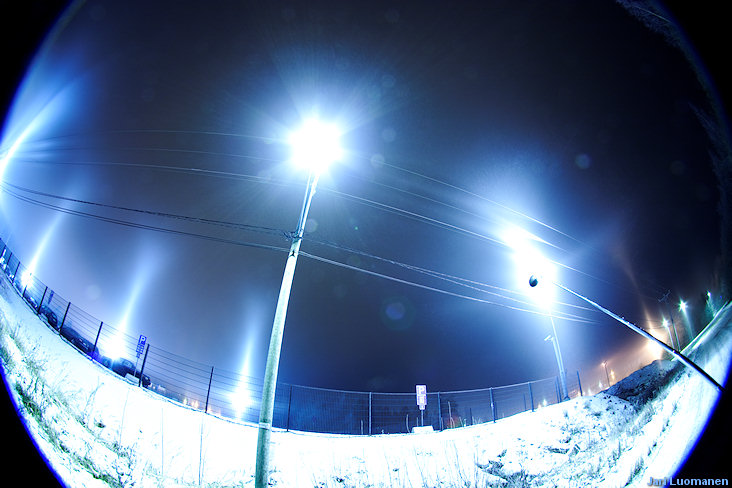
Divergent light parhelia as well as upper and lower tangent arcs were also observed. The divergent light upper tangent arc can be distinguished as the diffuse glow above the lamp. In the telephoto shot it manifests itself in the individual crystal trails between the camera and the cables. In this sense, the image shows two halos on top of each other. Strong pillars and UTAs were observed above light sources further away (see image 2).

The effect around the cables had a 3D appearance, like a vortex or a funnel, but it did not extend towards the observer. Rather, it seemed to encapsule the cable. The other halos that formed in the light of this lamp had a strong 3D character. Both tangent arcs as well as the parhelia arched along the Minnaert’s cigar from the eye of the observer towards the lamp. Unfortunately, this 3D effect cannot be satisfactorily captured in a still photograph.

Earlier that night it had proved difficult to photograph crystal samples due to high temperature. Towards the end of the display the temperature had risen to -3 degrees Celsius. Hence, no crystals were photographed during the observation. However, the known halos observed suggest that singly oriented columns and plates were prominent in the crystal population.

At the time of the writing (10 December 2007), the cause of the effect remains unknown. Hypothesises concerning the nature of the effect are most welcome as are previous observations in case there are any.

For larger images, see here.

2007. december 8., szombat

New home for Halo Reports


Because users are increasingly unhappy about the terms of use for the Blogger, we have decided to move the Halo Reports to another server. The new home is at the Ursa Astronomical Association server. Veikko Mäkelä made all the ground work. No more postings can be done to Halo Reports here, at the Blogger. With time, we try to move the old postings to new home so that the Halo Reports here at Blogger could be permanently removed.

The panorama is from Rovaniemi in the end of November.

2007. december 5., szerda

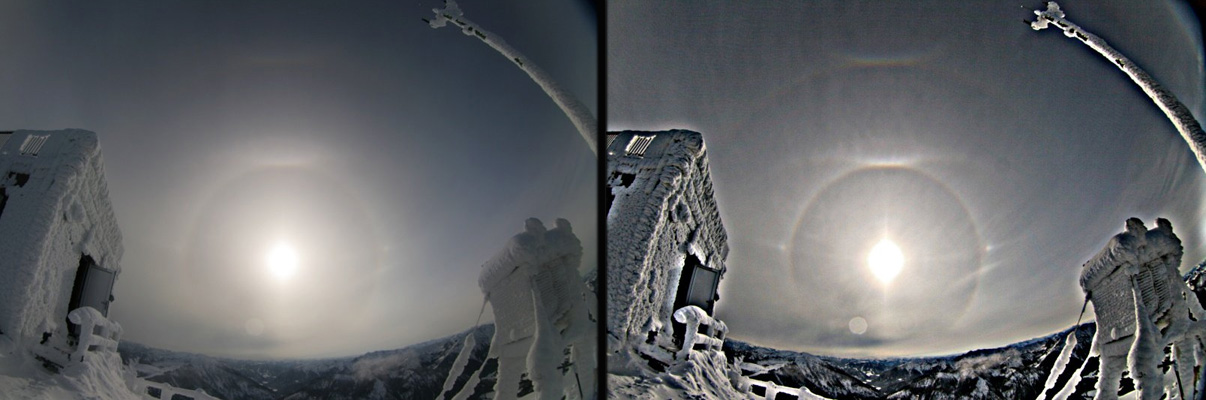
Sky Haloes in Southern Germany

this year only few haloes appeared over Germany, I could observe the second complex halo display on Mt. Wendelstein. In the morning I saw my first subsun in this year, which appeared in freezing fog. Later a veil of cirrostratus from a low pressure area over the Mediterranean Sea crossed the Alps from the south. Under those weather conditions, large halo displays can be seen very often. In my own statistics, 80% of all larger halo displays appeared when there was a southerly stream of air over the Alps, or under foehn conditions. And also this time there was a large choice of haloes in the southern part of the sky, which lasted for about two hours and a half. Between 10.10 and 12.45 CET the 22°-halo, a bright upper tangent arc and a faint Parry arc, both sundogs with Lowitz arcs, the parhelic circle, an almost complete supralateral arc, a faint infralateral arc on the right side, and a complete sun pillar were visible. Unfortunately, the haloes appeared only over a small area on the northern rim of the Alps. So except of me, only my husband who was down in the valley at that time, could enjoy similar haloes.

Text: Claudia Hinz