A következő címkéjű bejegyzések mutatása: Halo information. Összes bejegyzés megjelenítése

2008. április 5., szombat

A halo on Mars and other papers by Gunther Können

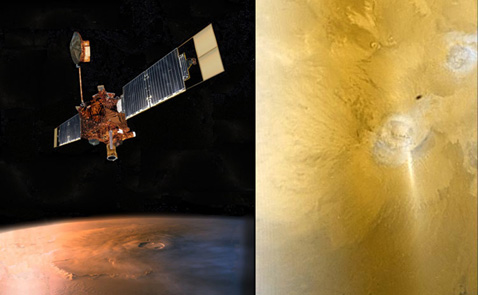
Gunther Können, who has produced a decent number of halo papers, has put his works on-line. These are found in the atmospheric optics section of his web page ( 1 ). Among others, there is an article about subsun on Mars (right photo), as photographed in 2006 by Mars Global Surveyor (left photo). Also, the extensive work on halo systematics, "A general setting for halo theory" by Tape and Können, is available.

Image credits:
left - NASA/JPL-Caltech/Corby Waste
right - NASA/JPL/Malin Space Science Systems

2008. február 11., hétfő

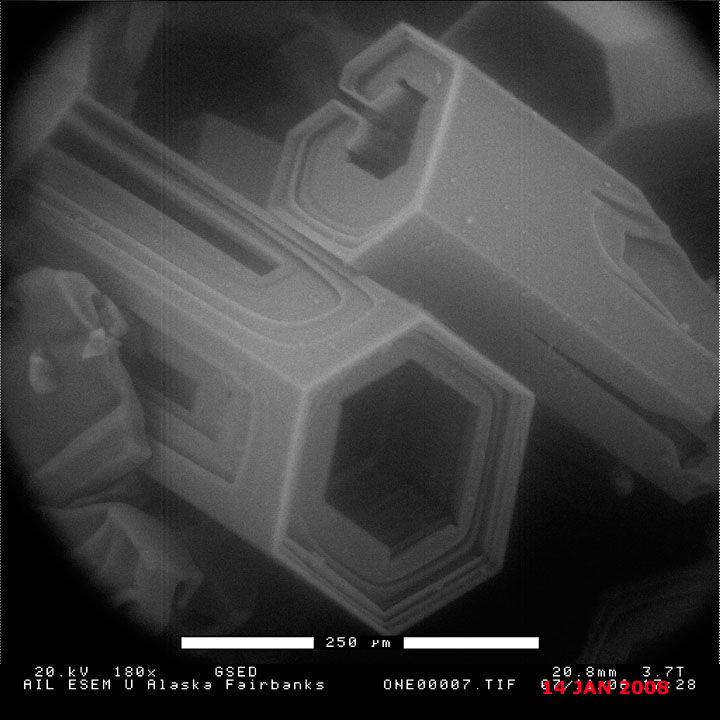
ESEM column crystal photo

Column crystals are a dime a dozen, but the ones shown here are nicely positioned and thus unusually revealing. Although we were collecting atmospheric crystals at the time, these monsters are probably frost crystals from the dewar mouth that fell into the liquid nitrogen and contaminated the sample. The photo is by Tom Kircher at the Advanced Instrumentation Lab, University of Alaska.

Text: Walt Tape

2008. január 28., hétfő

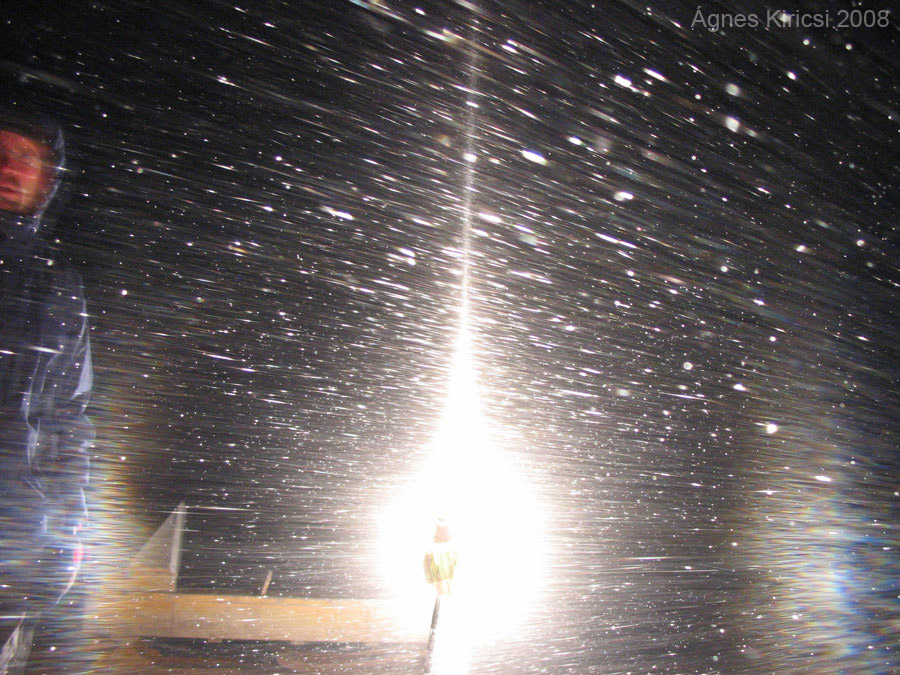
Making halos in Kilpisjärvi

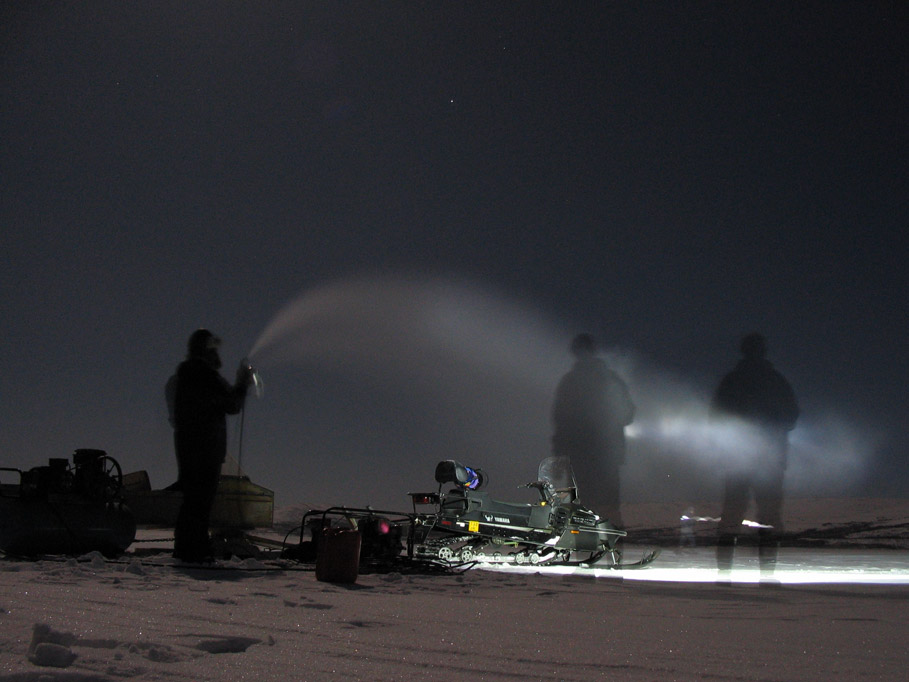
On 19th January the four of us, Jukka Ruoskanen, Marko Mikkilä, Ágnes Kiricsi and Marko Riikonen gathered at the Kilpisjärvi biological station in northern Finland to make halos. We had got some evidence that weather conditions in the Kilpisjärvi area might be favourable for ice crystal formation as long as the nuclei are provided. At his home, Marko Mikkilä had already done successful initial experiments of creating halos with a mixture of kaolin and water sprayed in the air, and this time we wanted to do more tests on the system.

During our one-week stay, we were able to create displays on two days and three nights, the temperatures being around -20 °C. The diamond dust cloud that developed seemed to be kilometres wide. This was accomplished with only about 10 litres of water and two spoonfuls of kaolin. The crystal swarm usually lasted about half an hour and then it was time to go back to spray more ( 1 – 2 ). On one night we succeeded in making halos 12 hours continuously.

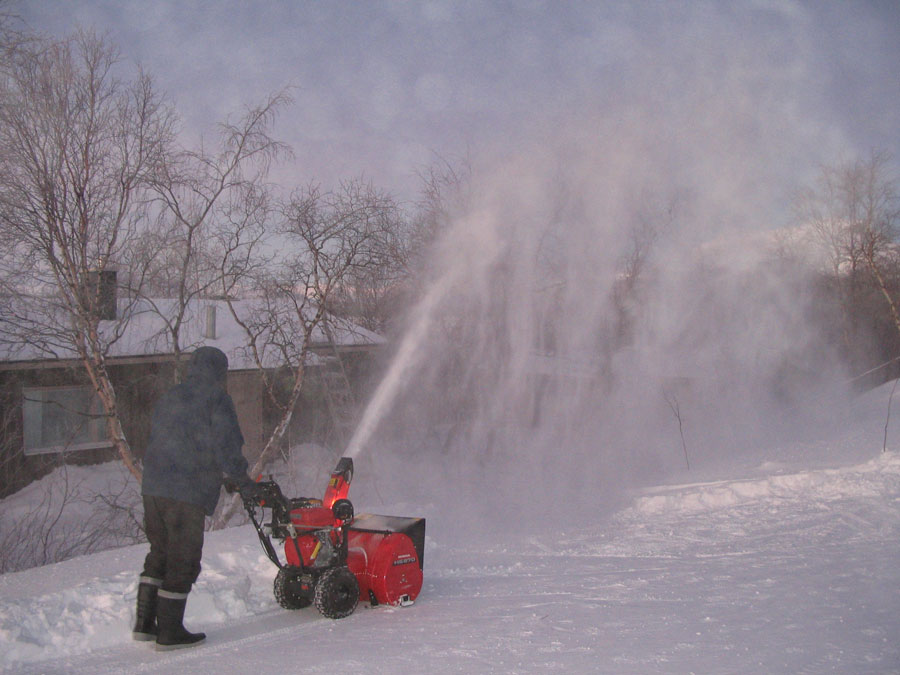
We also tested a snow blower. A good display had been observed ten years ago in Resolute Bay created by such a machine (see drawings in Sivuaurinko 3/98 on pages 9 and 10). Our impression was, however, that it was not nearly as good as kaolin, and we eventually quit using it.

Mostly we had plate displays ( 1 - 2 ), but on two nights at the beginning of the favourable conditions there were also halos from column and Parry oriented crystals. Diffuse arcs and upper sunvex Parry arc were seen. Moilanen arc was present only on one night for a short while.

We also tried spraying water mixed with montmorillonite (also known as bentonite) on one day and managed to create a weak plate display. This clay mineral is referred to be an even better nucleator than kaolin, but we found its use problematic because of its clumping habit.

After each spraying round photographing the halos was sort of a hassle, there was not much time for fine tuning. The next step in halo making is to have a continuous automated feed of the nucleating mixture. Then the real fun can start.

Text: Ágnes Kiricsi, Marko Riikonen
2007. december 28., péntek

halo search engine

Google has created a new service, "Custom Search Engine". I used this service to create a "Halo search" - search on all good sites dedicated to halo phenomena. This service can be used on any webpage (simple script), or on the home search page.

For example, when I try to search Minnaert's cigar in Halo Seach - I get 3 links, then try to search in a google "Minnaert's cigar" - 4 link, then in google, but Minnaert's cigar (without "") - 341.

You are welcome to use and improve it.

2007. december 24., hétfő

Crystal Swarm Effects


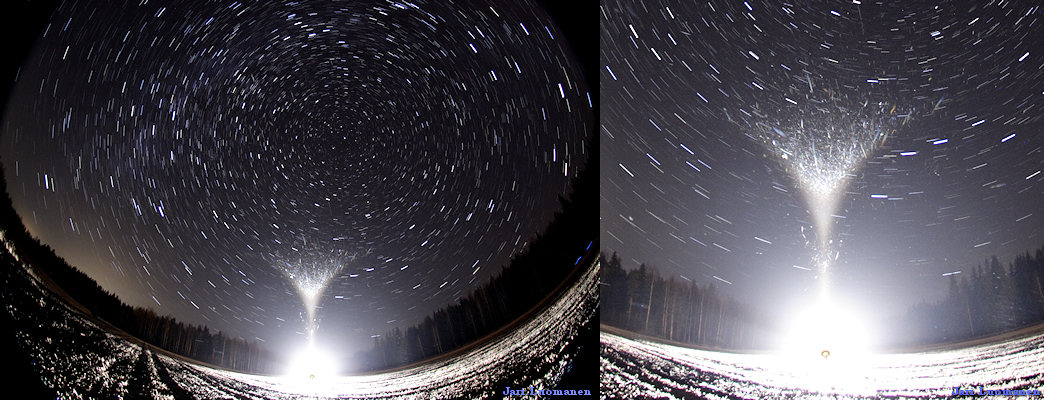
Divergent light halos can exhibit peculiar effects that are attributable to a homogenous or nonhomogenous crystal swarm. Here we present two such effects, where different parts of the "Minnaert cigar" are present in halos.

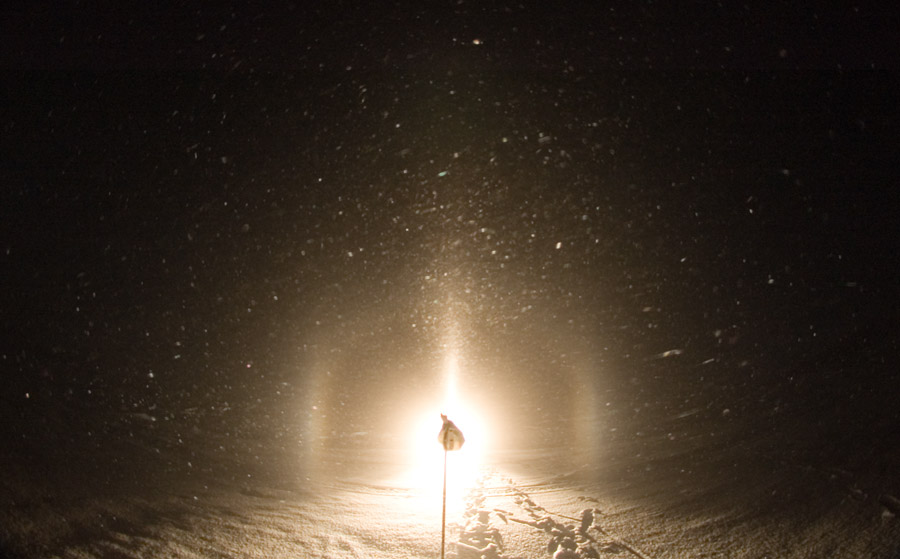
Image 1 displays a strong upper tangent arc (the whole frame and a crop is provided). It consists of two distinct parts: the upper part formed in bright separate glints and the lower more diffuse part. The diffuse part of the arc is formed in crystals further away from the camera, narrowing along the Minnaert cigar towards the lamp. The upper part is formed in crystals closer to the camera.

It is perhaps worth pointing out that the Moilanen arc is visible only in separate glints. This suggests that in this display it only formed in crystals closer to the camera, hit by relatively non-divergent rays.

The crystal swarm was homogenous as it had already travelled few kilometres from the snow guns. Total exposure time for the image 1 is 630 seconds.

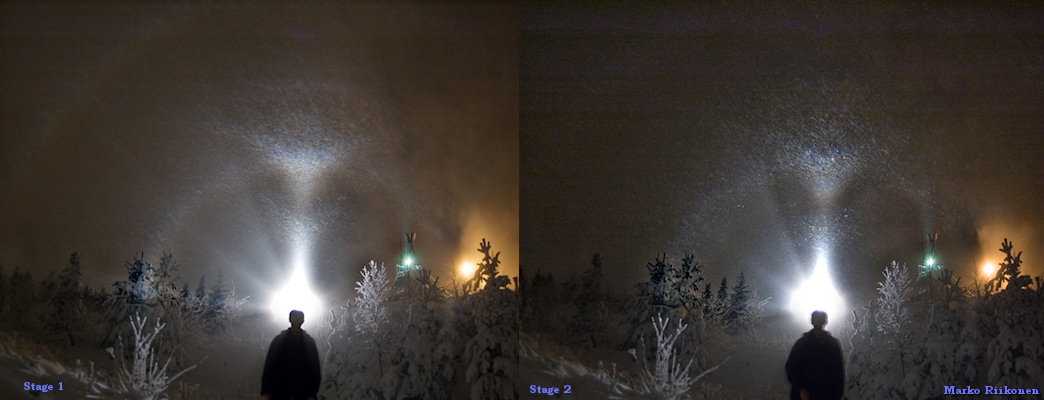
Image 2 presents two photos of different stages of a display. During stage 1 the halos look familiar: 22° halo, upper tangent arc and Parry arc among others are present. During stage 2, however, some curious changes have occurred. It looks like the tangent arc has shifted towards the lamp. Also, less clearly, there is a section of an additional circular halo on the left, apparently having the same radius as the shifted tangent arc.

The effects observed during stage 2 must be caused by inhomogeneity of the crystal cloud between the observer and the lamp (the snow guns were right next to the point of observation). The crystal swarm was more concentrated close to the lamp causing the shift of the tangent arc and 22° halo along the Minnaert cigar. This is supported also by the weakening of these halos at their normal radii, formed in close by separate crystals (compare to stage 1). An animated gif is provided for an easy comparison.

These shifted halos represent a vertical cross section of the Minnaert cigar close to the lamp. Horizontal cross section of 22° halo has been documented on snow surface, as shown by these photographs: surface halo 1, surface halo 2.

Marko Riikonen & Jari Luomanen

2007. december 15., szombat

Home Made Halo


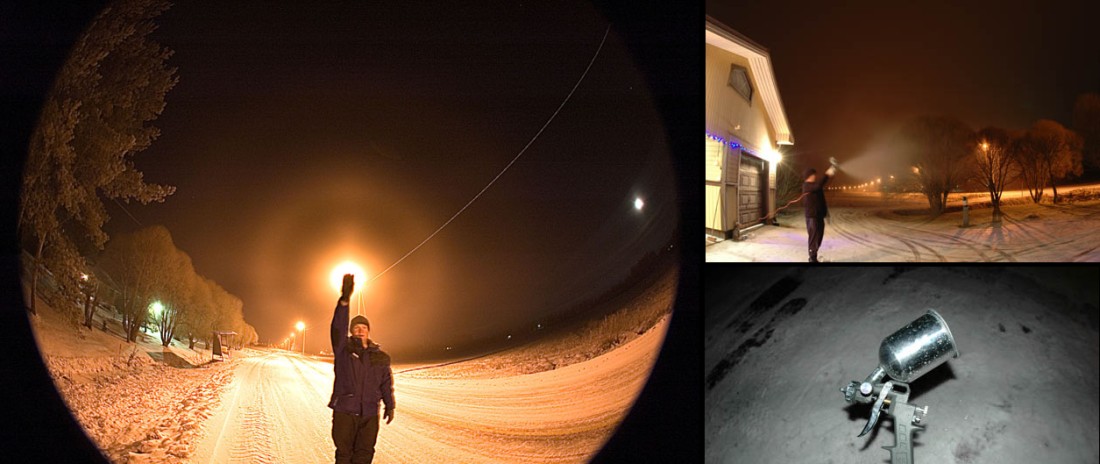
During the past year and a half I have tried to figure out how to build a Snowgun. Or, rather, an ice crystal gun since snow is not needed for creating halos. Hence, the objective has been to construct a "halo gun".

After some unsuccesful experimenting I came up with an idea of mixing small amounts of kaoline with water and spraying the solution into air. Kaoline is low cost material mainly used in ceramic industry. The halo gun itself is a simple device: all is needed is an air compressor and a paint spray gun.

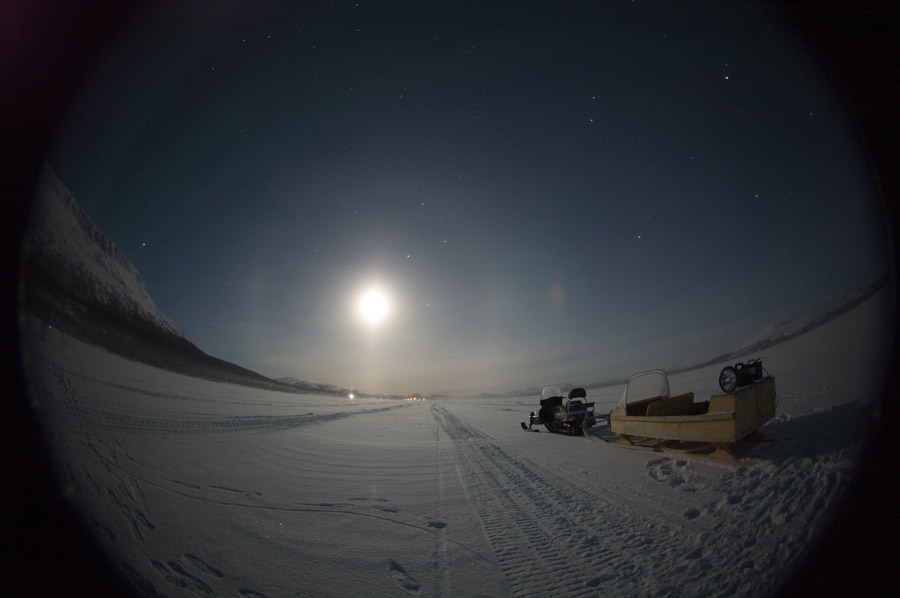
On 28 November the weather finally allowed for testing the device. When sprayed into air the solution immediately transformed into ice crystals. I followed the crystal swarm to a nearby road to see whether it created any halos. It certainly did. After the second spraying the halos got even better. I observed both 22 and 46 degree halo, CZA, UTA, M-arc, parhelia, and parhelic circle. The above photograph was captured during the peak of one halo gun generated display.

The halo gun even worked with hot water which prevented the nozzle from freezing. Without Kaoline I was not able to produce ice crystals, regardless of the temperature of the water. Clearly, kaoline plays a huge part in the nucleation process.

Thus far the highest temperature where I have successfully created haloes using this method has been as high as -2 degrees celsius. This ice nucleation temperature is significantly higher than what is cited for Kaolin in various sources in literature. Similar high-temperature ice nucleation characteristic is known for Pseudomonas syringae bacterial protein, which is commonly used to intensify snow production in snow guns.

In January we will go with a small group of people to Kilpisjarvi biological station in the northhernmost Finland to experiment more thoroughly with halo making.