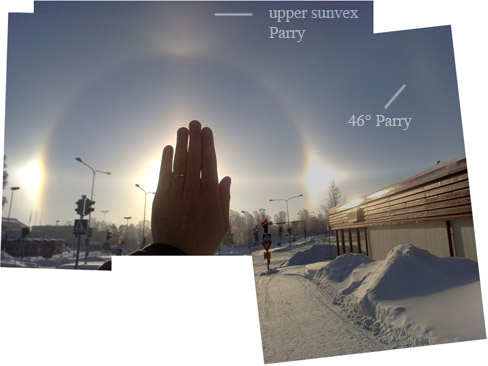
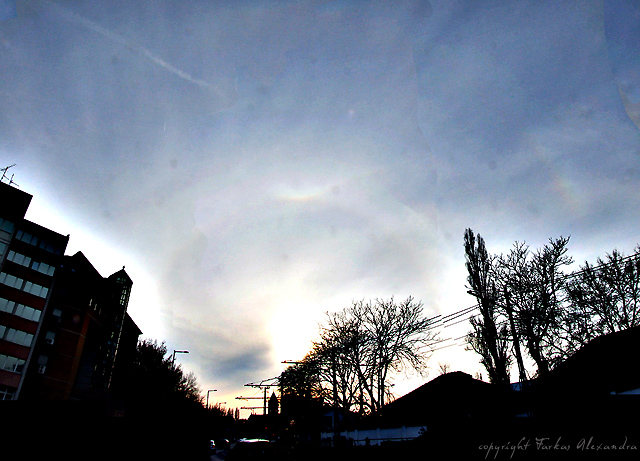
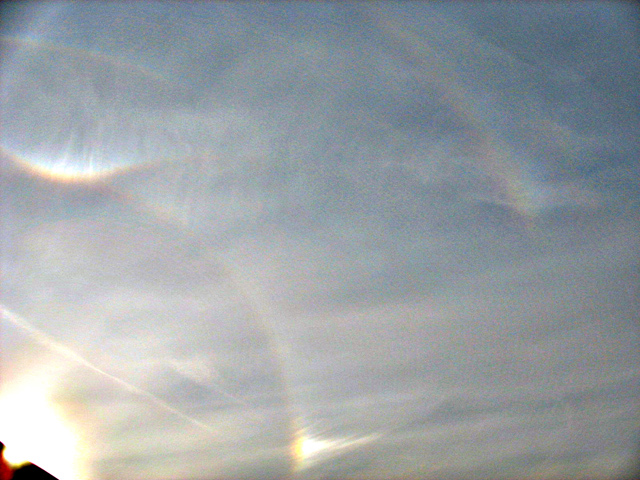
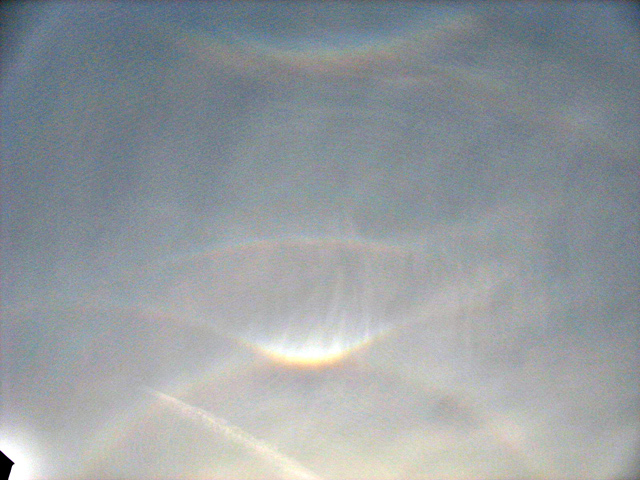
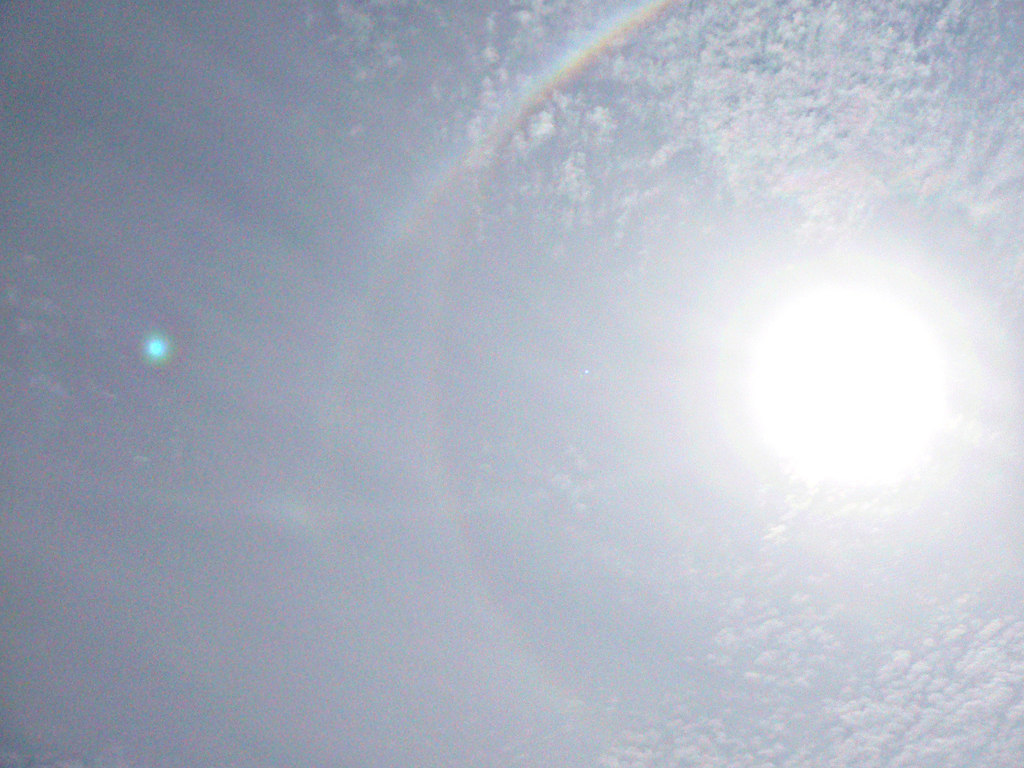
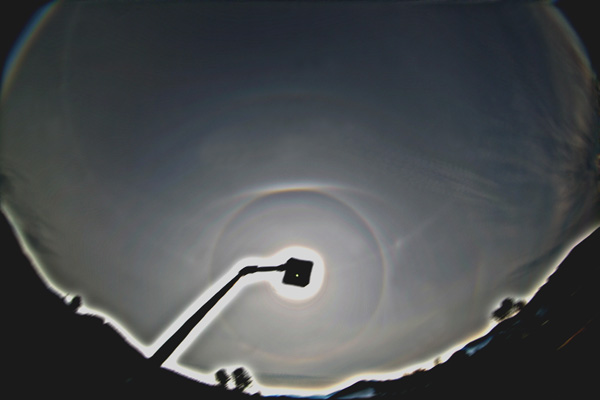
Miika Karppinen photographed this display in the town of Kajaani on 8 March this year. Upper sunvex Parry arc and 46° Parry arc are weakly present ( 1 ).
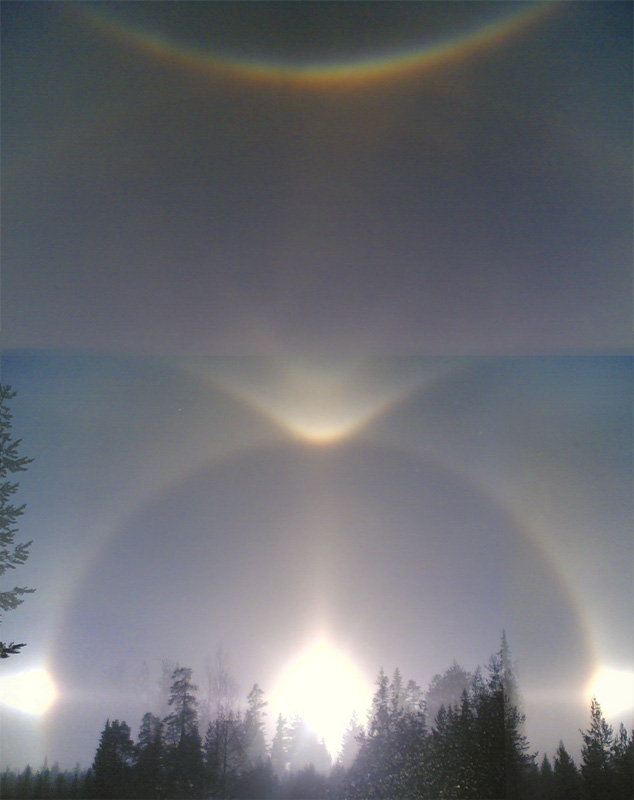
The other display occurred on 26 October 2006 in Salla ( 2 ). Photos were taken by Jani Päiväniemi. Under the circumzenith arc there is a patch of 46° halo, which could be indication of 46° contact arc. First convincing photos 46° contact arcs were taken three days later in Muonio ( 3 ).
Both Kajaani and Salla displays were captured with cell phone cameras.
2008. május 14., szerda
2008. május 7., szerda
Wegener Arcs in Finland
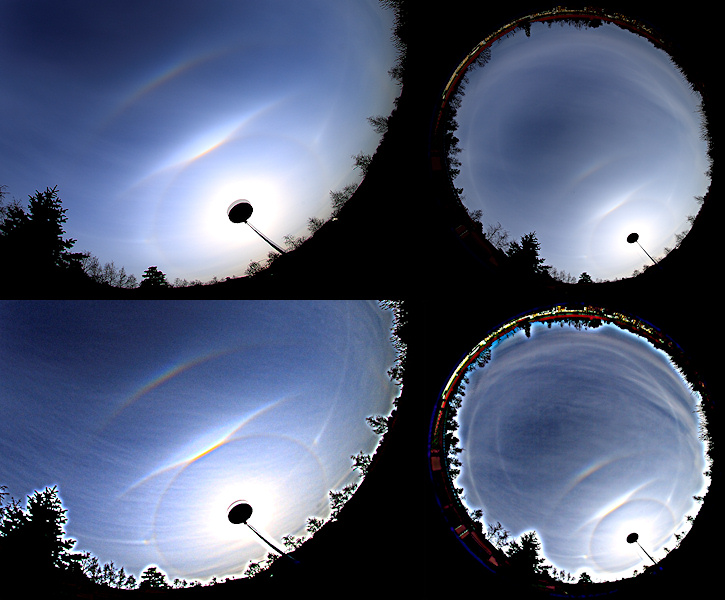
Long absence of rare high cloud halos in Tampere skies was brought to a sudden end by a complex display on 2 May 2008. Singly and Parry oriented columns played the key roles: among the more common halo forms the display featured an upper suncave Parry arc and Wegener arcs.
Sun elevation was ca. 27 degrees. Both photos are stacked images (no longer than 5 minutes' time period for each). Below them contrast enhanced versions are provided. Also, larger images are available online ( 1 ).
2008. május 2., péntek
Complex displays in Eastern Europe
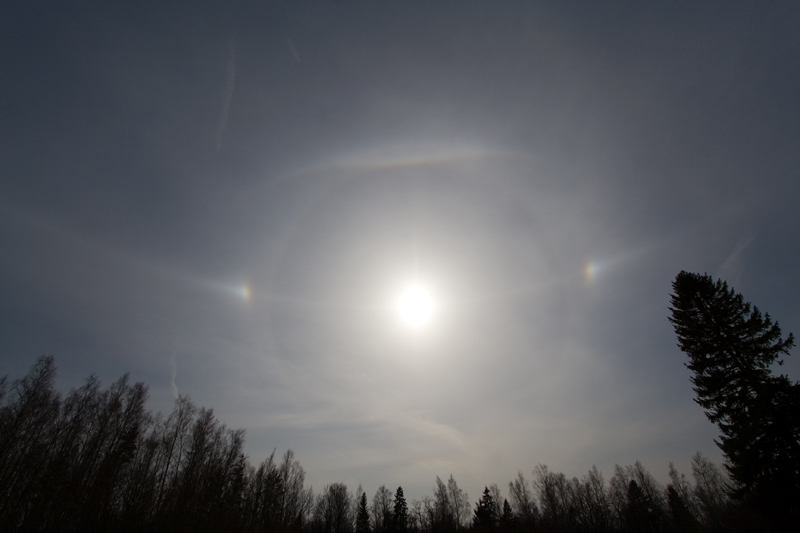
A series of complex halo displays occured in Eastern Europe between 27 March and 6 April. The first display was seen in Vecsés, Hungary (observer: Ágnes Kiricsi). On 27 March, after the appearance of a bright circumscribed halo, a growing stretch of the parhelic circle came to sight ( 1 ) and 120° parhelion showed up on the left ( 2 ). The parhelic circle was complete for about 5 minutes.
Close by in Budapest, a Tape arc was observed in the evening. Images were taken by Alexandra Farkas and Tibor Hollósy ( 3 and enhanced 4 ). They did not see other halos formed by Parry oriented crystals, but 7 km to the north of them and only 3 minutes earlier, Márk Laczkó had photographed an upper suncave Parry arc ( 5 - 6 ).
The next Hungarian observations of complex displays with complete or almost complete parhelic circles were on 1 April (Ágnes Kiricsi in Vecsés) and on 5 April (Alexandra Farkas, Tibor Hollósy in "Remete" Gorge).
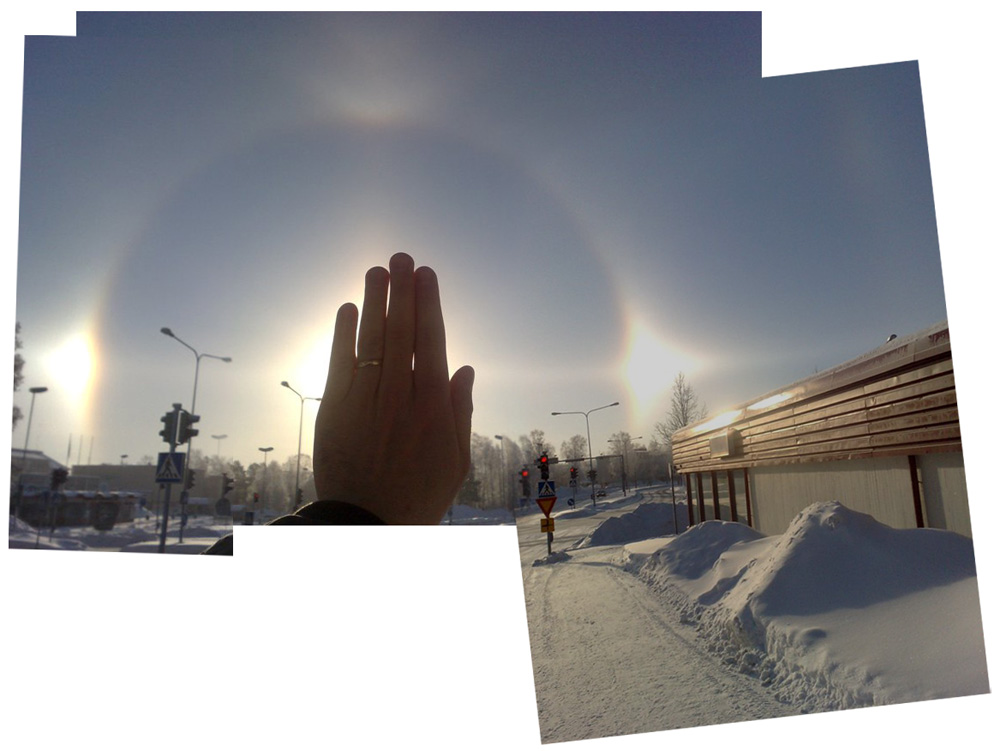
On 2 April, Marko Krusel had an opportunity to observe a complex halo display in Estonia, nearby Keila (see image on top). Besides all the common halos, he got an upper suncave Parry arc, a full parhelic circle and 120° parhelia. A fragment of the infralateral arc was seen on left. The show ended with the parhelic circle and 120° parhelion as the latest leavers ( 7 ).
6 April was a favourable day for the Czech Republic and Poland. The Czech Matej Grek (Ostrava-Dubina) and Martin Popek (Nydek) both photographed complex displays with parhelic circles and bright circumscribed halos. A 46° halo was also visible ( 8 - 9 ). In southern Poland Jakub Marchewka observed a display with full parhelic circle in Chrzanów ( 10 - 11 ). From the photos he noticed a faint Wegener arc ( 12 and enhanced 13 ) and 46° halo ( 14 and enhanced 15 ).
It was a first observation of Wegener in Poland and one of the first of 46° halos. The latter was described by Johannes Hevelius on 20th February 1661 in Gdańsk, but it is likely that supralateral and infralateral arcs were the main contributors to the phenomenon.
Text: Marko Krusel, Jakub Marchewka and Ágnes Kiricsi
Close by in Budapest, a Tape arc was observed in the evening. Images were taken by Alexandra Farkas and Tibor Hollósy ( 3 and enhanced 4 ). They did not see other halos formed by Parry oriented crystals, but 7 km to the north of them and only 3 minutes earlier, Márk Laczkó had photographed an upper suncave Parry arc ( 5 - 6 ).
The next Hungarian observations of complex displays with complete or almost complete parhelic circles were on 1 April (Ágnes Kiricsi in Vecsés) and on 5 April (Alexandra Farkas, Tibor Hollósy in "Remete" Gorge).
On 2 April, Marko Krusel had an opportunity to observe a complex halo display in Estonia, nearby Keila (see image on top). Besides all the common halos, he got an upper suncave Parry arc, a full parhelic circle and 120° parhelia. A fragment of the infralateral arc was seen on left. The show ended with the parhelic circle and 120° parhelion as the latest leavers ( 7 ).
6 April was a favourable day for the Czech Republic and Poland. The Czech Matej Grek (Ostrava-Dubina) and Martin Popek (Nydek) both photographed complex displays with parhelic circles and bright circumscribed halos. A 46° halo was also visible ( 8 - 9 ). In southern Poland Jakub Marchewka observed a display with full parhelic circle in Chrzanów ( 10 - 11 ). From the photos he noticed a faint Wegener arc ( 12 and enhanced 13 ) and 46° halo ( 14 and enhanced 15 ).
It was a first observation of Wegener in Poland and one of the first of 46° halos. The latter was described by Johannes Hevelius on 20th February 1661 in Gdańsk, but it is likely that supralateral and infralateral arcs were the main contributors to the phenomenon.
Text: Marko Krusel, Jakub Marchewka and Ágnes Kiricsi
Feliratkozás:
Bejegyzések (Atom)