2007. szeptember 9., vasárnap

Anthelic arcs in Finland


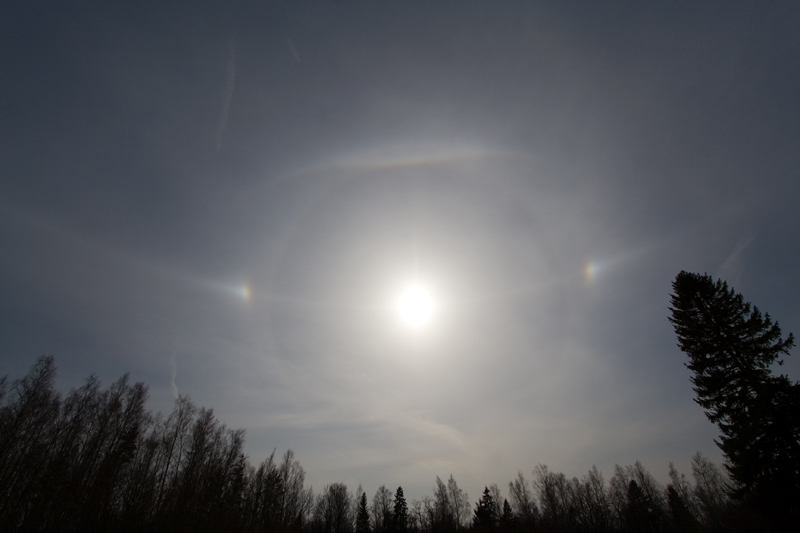
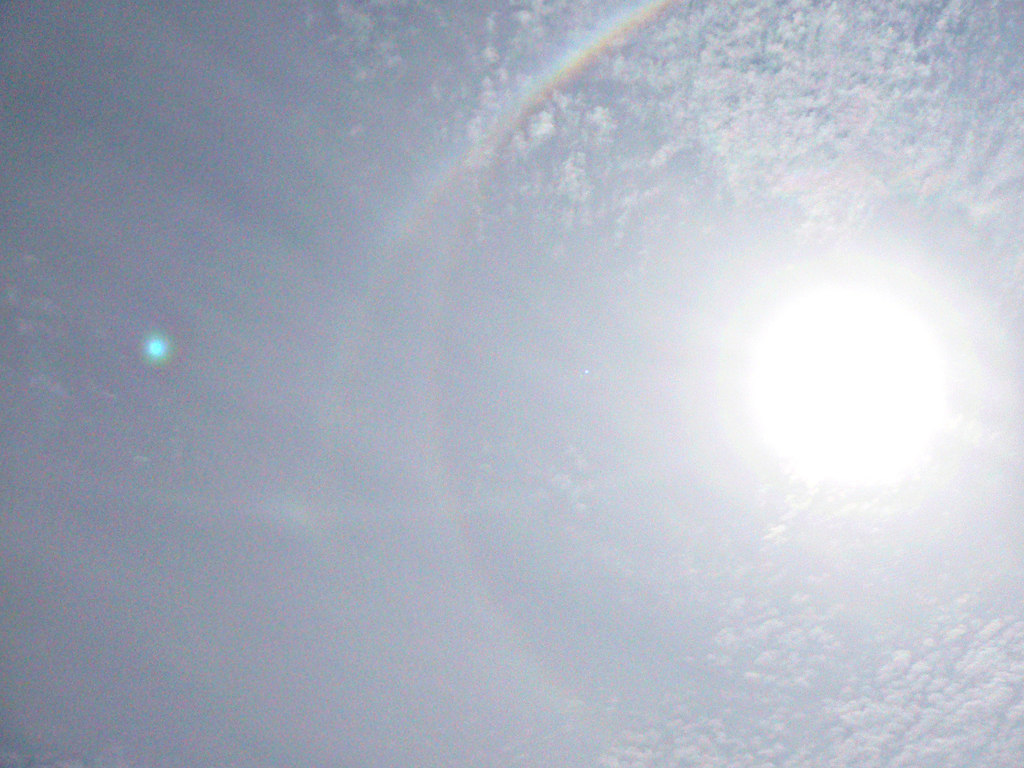
On August 28th anthelic arcs appeared in the northern part of Finland. My coffee break was suddenly halted as watching from the window I noticed several arcs. Once outside my eye was first caught by well developed parhelic circle. Then, looking up I noticed a colourful Wegener arc. Colours were red on the bottom and blue on the upper part. In the later stage of the display I noticed faint X at the anthelion indicative of the diffuse/Tricker arcs. I had no camera but my friend borrowed his camera equipped cellphone. Image quality is quite poor, but halos are still recognizable. Also Parry arc and 120 parhelia were present. Other halos were 22halo, parhelia, 22 upper tangent arc, parhelic circle, circumzenith arc, infralateral arc and supralateral arc. The display was noticed over large areas in Finland. More photos is here. Also see the photos by Arto Oksanen and Panu Lahtinen

2007. szeptember 2., vasárnap

Bright 120° parhelion over The Hague


Sunday, September 2nd 2007, The Hague, The Netherlands

After a cloudy morning, the low clouds broke up and both the sun and higher cirrus clouds became visible.

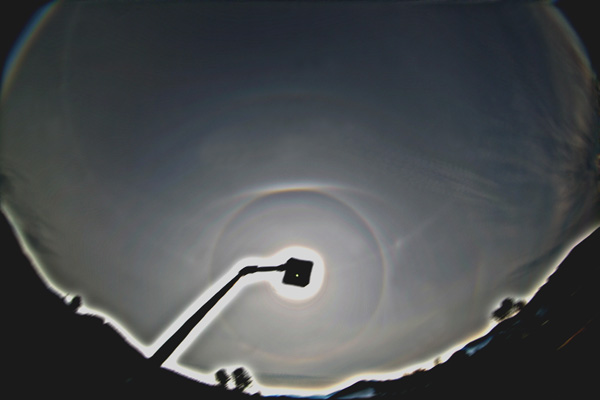
The appearance of the cirrus was an indication for me, to keep a keen eye on the sky. That policy was worth-while, because a short time later, at about 11.35 C.E.S.T., a part of the Parhelic circle appeared, together with a remarkably bright 120 deg. Parhelion, in NNE-ly direction. Both the parhelic circle and the Parhelion presented a clear brownish-reddish fringe colouring. Immediately, I fetched my mobile-phone-with-camera, and made the picture, accompanying this message.

Frank Nieuwenhuys

2007. augusztus 16., csütörtök

Elliptical halos over Deventer


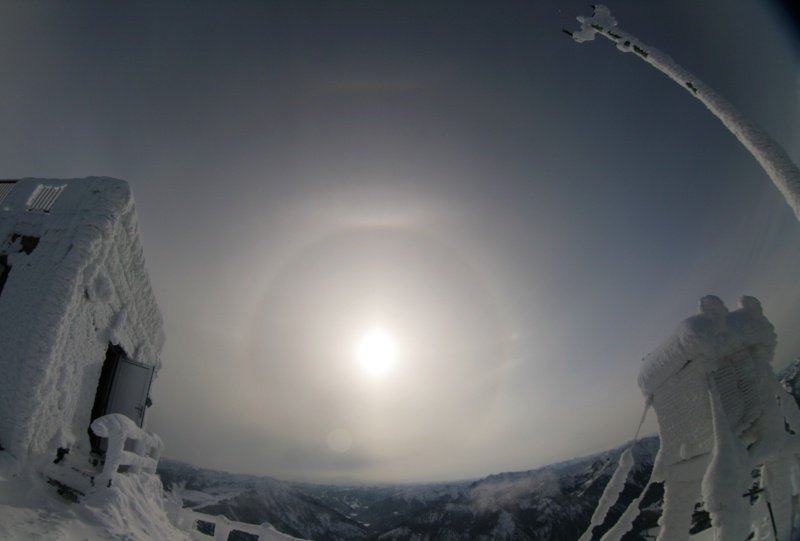
14 August 2007 - At the edge of a large, smooth-structured Altocumulus bank, elliptical halos appeared at 1100, and from 1113 to 1120 UTC. In the first stage, the halo was complete and quite bright, although hardly coloured. It remained too short to get the camera ready. In the second stage, the halo was quite bright as well, and uncoloured, and sometimes partly covered by the continuously passing-over Altocumulus edge. Several photographs were able to be made (Nikon D80, AF-S Nikkor justed on 45mm). At 1113 UTC there were sections of two different elliptic halos visible. The inner remainded visible and was complete, even shining through the Altocumulus. The Altocumulus became increasingly dense and halos disappeared at 1120 UTC. Solar elevations from 51.7 to 51.9degs.

Peter-Paul Hattinga Verschure, Deventer The Netherlands

2007. augusztus 14., kedd

Pyramidal halos 8-14-07


After weeks of seeing no nice halo displays I was at work today on breaktime and I saw 22 halo and upper 22 deg tangent arc. I put my sunglasses on and I soon realized I had an odd radius display at hand. In all there was 9 deg. halo 18 deg halo and the outer halo who knows it could be 22 or 23 or a combo of both. The upper arc is convincing it looks sharp and I think it might be 22deg upper column arc but not sure. One photo is an original and the other has USM applied to make the halos stand out better. This is a good odd radius display for me but I know there is a lot better.

2007. augusztus 4., szombat

Complex displays in Eastern Europe

A series of complex halo displays occured in Eastern Europe between 27 March and 6 April. The first display in this series was seen in Vecsés, Hungary (observer: Ágnes Kiricsi). On 27 March at 13:30, after the appearance of the shining 22° and circumscribed halos, the parhelia started getting brighter and brighter, and together with them, a growing stretch of the parhelic circle came to sight ( 1 ). In about a quarter of an hour, as the clouds were passing towards the east, the 120° parhelion showed up on the left ( 2 ). The phenomena lasted until 14:10 with the complete parhelic circle visible for about 5 minutes.

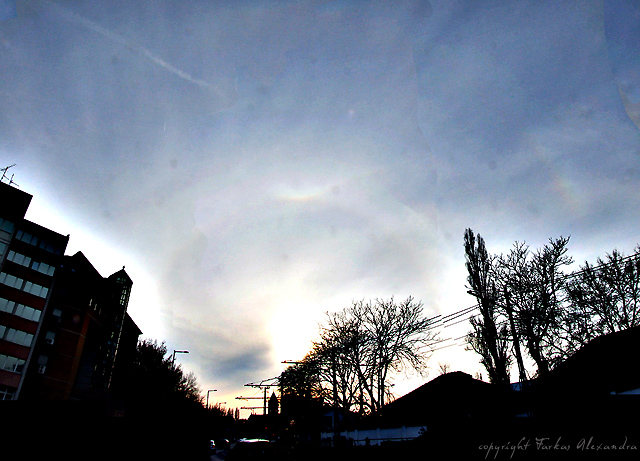
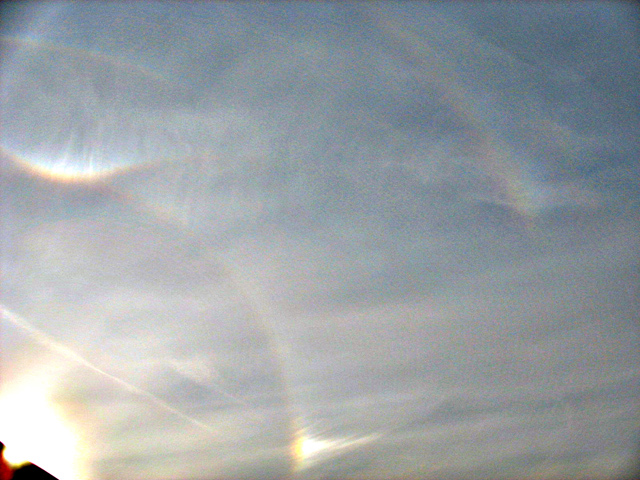
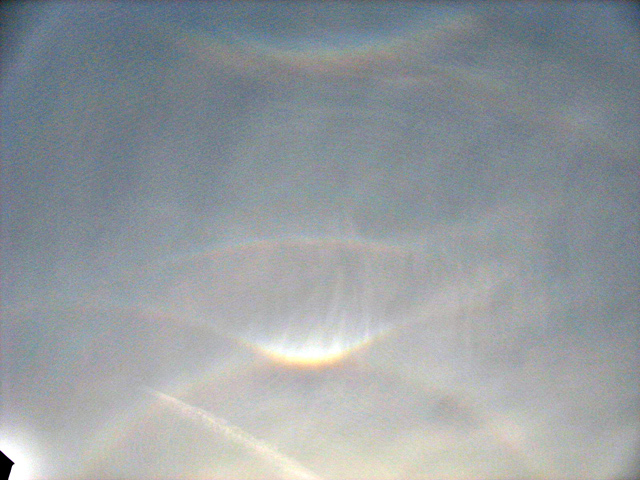
The display continued until sunset with a 22° halo, parhelia, upper tangent arc, circumzenith arc and supralateral arc. In Vecsés, the clouds started thickening, but in Budapest the conditions got better at this time of the day. In a rather narrow stretch over the capital, a Tape arc was observed between 16:40-16:56. Images were taken by Alexandra Farkas and Tibor Hollósy ( 3 and enhanced 4 ). They did not see other halos formed by Parry oriented crystals, but 7 km to the north and only 3 minutes earlier, Márk Laczkó had photographed an upper suncave Parry arc ( 5 - 6 ).

In Hungary, there were two other observations of complex displays with complete or almost complete parhelic circles. One on 1 April (Ágnes Kiricsi in Vecsés), the other one on 5 April (Alexandra Farkas, Tibor Hollósy in "Remete" Gorge).

On 2 April, after a long time period, Marko Krusel also had an opportunity to observe a complex halo display in Estonia, nearby Keila. The peak time was 14:30, when the sun was 30.9 degree above the horizon and the sky was covered by cirrostratus haze. Besides all the common halos like 22° halo, upper and lower tangent arcs, parhelia, supralateral arc and CZA, he also got a bright upper suncave Parry arc, a nice full parhelic circle and 120 degree parhelia. A fragment of the infralateral arc was also seen on left. The show ended at 16:00.
Suprisingly the right side parhelic circle and 120 degree parhelion were the latest leavers ( 7 ).

6 April was a favourable day for the Czech Republic and Poland. The Czech Matej Grek (Ostrava-Dubina) and Martin Popek (Nydek) both photographed complex displays with parhelic circles and bright circumscribed halos. A 46° halo was also visible ( 8 - 9). On the same day, Jakub Marchewka also observed rare halos in Chrzanów in the south of Poland. He saw well-defined 22° halo with parhelia, circumscribed halo and full parhelic circle on cirrostratus ( 10 - 11 ). When he looked through the photos he had taken, he noticed a faint Wegener arc ( 12 and enhanced 13 ) and 46° halo ( 14 and enhanced 15 ). It was a first observation of Wegener in Poland and one of the first of 46° halos. On 20th February 1661 Johannes Hevelius observed the Gdańsk halo display and he described a 46° halo. If he was right and did not mistake it for supralateral arc and infralateral arc, Jakub Marchewka's observation is the second in Poland.

Text: Marko Krusel, Jakub Marchewka and Agnes Kiricsi

Sky halos in southern Germany


Although this year only few haloes appeared over Germany, I could observe the second complex halo display on Mt. Wendelstein ( 1 ). In the morning I saw my first subsun ( 2 ) in this year, which appeared in freezing fog. Later a veil of cirrostratus from a low pressure area over the Mediterranean Sea crossed the Alps from the south. Under those weather conditions, large halo displays can be seen very often. In my own statistics, 80% of all larger halo displays appeared when there was a southerly stream of air over the Alps, or under foehn conditions. And also this time there was a large choice of haloes ( 3 ) in the southern part of the sky, which lasted for about two hours and a half. Between 10.10 and 12.45 CET the 22°-halo, a bright upper tangent arc and a faint Parry arc, both sundogs with Lowitz arcs, the parhelic circle, an almost complete supralateral arc, a faint infralateral arc on the right side, and a complete sun pillar were visible. Unfortunately, the haloes appeared only over a small area on the northern rim of the Alps. So except of me, only my husband who was down in the valley at that time, could enjoy similar halos ( 4 ).

Text: Claudia Hinz

2007. július 30., hétfő

Giving better looks for the stacked images


There is no denying it - stacked and unsharp masked halo image can be rather ugly. Ground objects are blurred and horizon is coated with blue glow.

But the looks can be improved by taking the ground from single untreated frame. That's what is done in the upper right image. It is the same image as the upper left except for the ground.

Near the horizon the clouds from the single frame dominate the sky, but in this case it has no significance as the halos are anyway blurred at the horizon. This technique works best with high sun displays where halos are far from ground objects.

The display was seen in Lahti on June 9. The upper image pair is stacked (using Registax) from 72 frames taken during 15 minutes. The lower is 60 frames /12 minutes stack. It shows lower 24 plate arc on the right and perhaps some 24 halo on the left. Jukka Ruoskanen also photographed the display some 40 kilometres from Lahti. Another example of the ground adding is here.