A következő címkéjű bejegyzések mutatása: reflected Lowitz arc. Összes bejegyzés megjelenítése

2007. június 11., hétfő

Subparhelia with reflected Lowitz arcs


Bill Burton, USGS, observed nice halo display with very rare reflected Lowitz arcs. Bill: "This photo showing an impressively bright sub-Sun and sub-parhelion was taken from the window of a commercial airliner on a flight from Anchorage to Minneapolis. I was looking down at a thin, cirrus cloud layer over the snow covered farmland of southern Canada when these wonderful halos and arcs appeared. The Sun is above the image, producing this sub-Sun and upward-facing portion of a 22-degree halo. This sub-Sun was brilliant enough to create its own sub-parhelion and 22-degree arc - on the right side of the image. Photo taken on January 11, 2007"
Text was assumed from EPOD

2007. február 2., péntek

Reflected Lowitz arcs in Finland


On 30th January 2007 I found that local district heating plant was causing a nice diamond dust display. Temperature was -22 C and the steam crystallized immediately. Only a few hundreds meters from the plant was already a plenty of crystals, but the best was about 2 km from the plant.

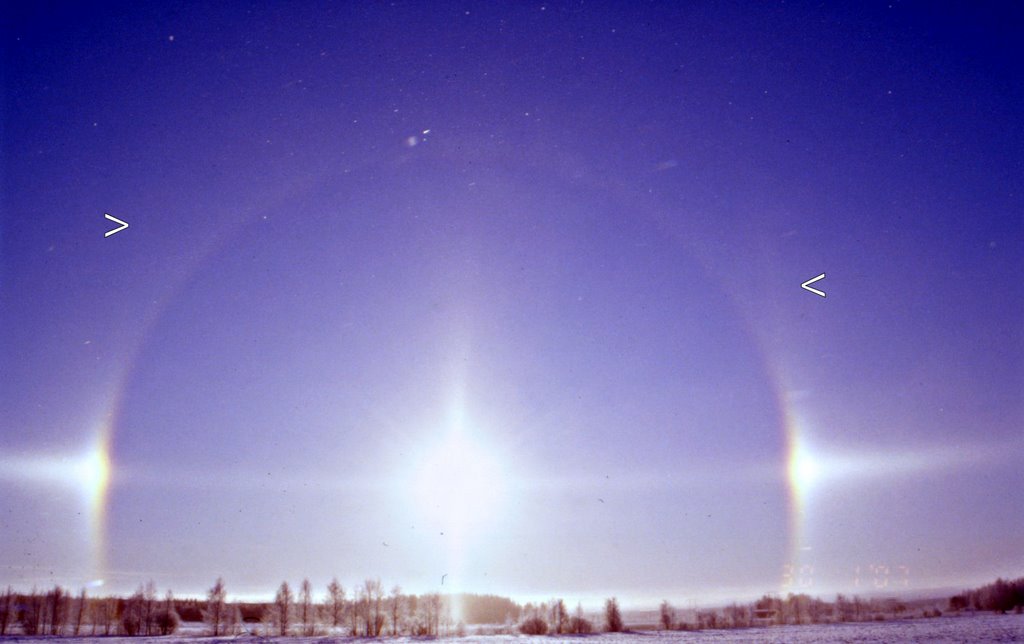
There I drove to a small road and got out and saw a display like never before. Parhelia were very bright, like fireballs. Also circumzenith arc was bright, but 22 halo was quite weak. Almost full parhelic circle was present with faint 120 parhelia, that looked more like pillars than fuzzy balls.

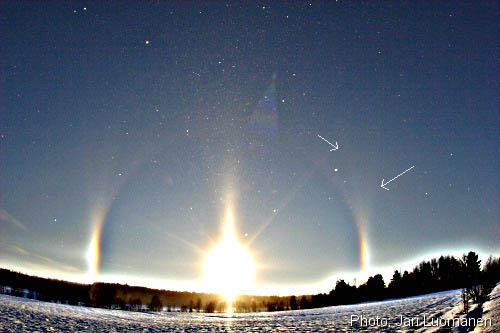
I had a film camera and eventually run out of film. The only choice was to drive home to get digital camera and fisheye lenses. On returning back the display had lost intensity and the 120 parhelia were completely gone. Anyway, I took about 80 photos with digital and later stacking of those photos revealed faint reflected Lowitz arcs rising up from the parhelia (marked in the photos with arrows). More photos of display is here. The looks of the display is quite similar to the one that was observed by Jari Luomanen a year ago. See photo here.