2006. január 31., kedd

Twenty years from first observation of Hastings arcs

Hastings arc is rare halo from Parry oriented crystals. It was predicted by C.S Hastings in 1920, but it wasn't until 1986 that it was first time observed, by Walter Tape at South Pole.

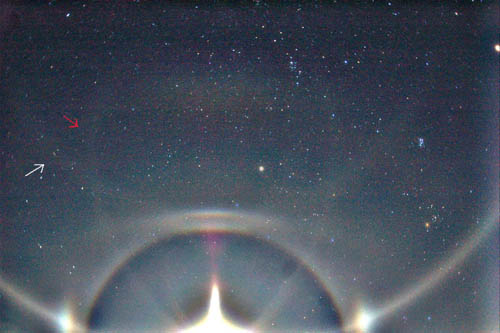
The photo on the left is the latest documentation of Hastings arc. This moon display was seen by Marko Mikkilä at Sievi last December. Like so many of the good diamond dust displays in Finland, it was also made by snow machines.

The image is stacked from 6 individual unsharp masked images. White arrow marks the Hastings arc, red heliac arc. The display resists succesful simulating. The broblem is the oddly short Parry arc. Mikkilä's simulations indicate towards plate shaped Parry crystals - a crystal falling mode that has been thought of as unrealistic.

Hastings arc looks much like the Wegener arc, except that it touches Parry arc instead of 22° upper tangent arc. Simulations series from Parry oriented crystals are here.

A list of known observations:

2006. január 30., hétfő

Nice display at Idaho

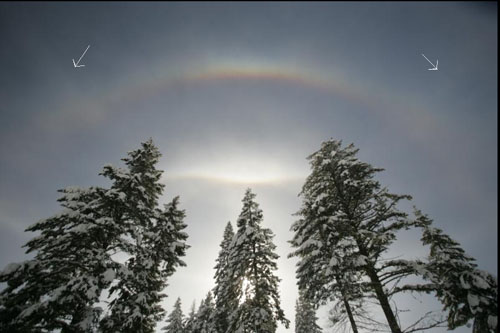
Walt Tape sent a note about this display that was photographed by Jim Grossman on 24. January 2006 at Tamarak ski resort in Idaho, USA. Among other more common halos, it shows also Wegener arcs (arrows).

Diamond dust halo displays near the ski resorts are usually generated by snow making. That seems to be also the case now: "There was limited snowmaking occurring at and below the inversion level, but about 1/2 to a mile away from and in the opposite direction from the display", tells Grossman.

These man made halo displays often get better as ice crystal cloud travels further away from the source. Probably this is due to crystals growing larger as they gather water vapor from the surrounding air.

A new book about halos


American Geophysical Union (AGU) has published a new halo book:

"Atmospheric Halos and the Search for Angle X"
by Walter Tape and Jarmo Moilanen

You can find description of the book here. You can order it from there too.

Carl Tape has opened a webpage for the book, you can find it here.

2006. január 29., vasárnap

Simulation of 44° parhelion

Here is a simulation of the Jaakko Tähti 44° parhelion display. In order to produce 44° parhelion (left arrow) in the simulation, multiple scattering has been used for plate crystal population. Reflected Lowitz arcs (right arrow) as well as 22° halo are simulated with "normal" single scattering populations.

Photo and simulations are also found here. Simulation is made with program by Mika Sillanpää and Jarmo Moilanen.

Patrik Trncak notified me about another likely case of photographed 44° parhelion. It was documented by Matthew Hyde in Greenland in summer 2002.

2006. január 27., péntek

44° parhelia, Minnesota


Jaakko Tähti</SPAN is to be congratulated!

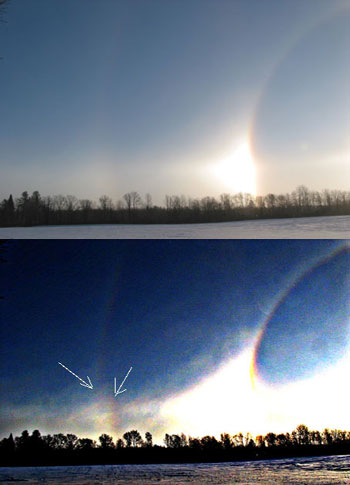
For completeness of the records, part of the Minnesota halos of 3rd January 2004 are shown here. The top image is 'as was' from the camera. Bright left and right hand 44° parhelia were visible in the display.

44° parhelion in Finland

Once thought to be an extremely rare halo, the 44° parhelia is now increasing it's appearances. The display on the right was photographed by Jaakko Tähti on 21. December 2005 at Viitasaari, Finland. To my knowledge, this is the eight photographed occurrence of 44° parhelion.

The formation of 44° parhelia differs from other halos in that it's not caused directly from sun rays, but from light rays of another halo - namely the common 22° parhelia. In other words, it is the parhelia of parhelia. Formation of 44° parhelia seem to require diamond dust conditions and very bright 22° parhelia. According to Jarmo Moilanen, also low sun elevation is essential to ensure there are enough ice crystals between the sun and observer. Here the sun elevation is 2°.

List of photographed occurrences of 44° parhelia:

Stockholm Display II

More images of Göte Flodqvist's display are on Mats Mattson's site - this page.