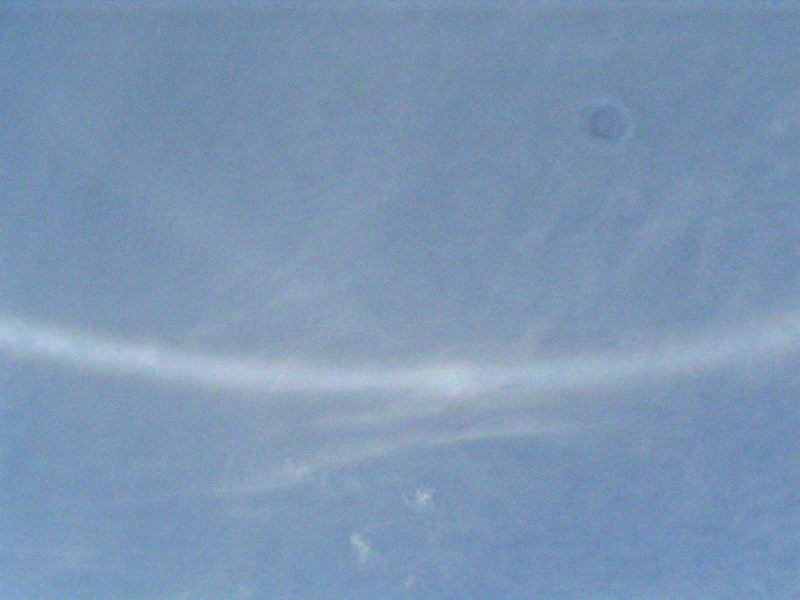
The most interesting feature of the display was probably the appearing of the anthelion with Wegener´s anthelic arcs attached to it. The left part of Wegener´s anthelic arc was clearly visible to the naked eye, but in the photographs also the right part seems to be faintly visible. One picture, processed by an unsharp mask, even gives the impression of a faint “halo-X” on the parhelic circle. The 120°-sundogs, were clearly visible too.
2007. október 10., szerda
Complex Halo Display with Wegener´s anthelic arcs in Germany
2007. október 7., vasárnap
Concave & convex Parry arcs photographed in Georgia
A visitor of my homepage emiled me this photo of a complex display that took place in Rome, Georgia and the year I can't remember but it was in the early 90's and of all the halos the bright upper concave and convex parry arcs are the most interesting. This is probably the best I have seen where both upper parry arcs are visible . Other images show a bright supralateral arc as well. The person who sent the photo is Loren Hall and his email is: bctimebandit@earthlink.com
Blue spot gets more colours

Blue spot is the colour feature of the parhelic circle occurring at the anthelic region of the sky. In addition to the blue, the theory predicts also green, but no red. Yet in several observations also red colour has been reported. However, because the red has never reproduced in photos, the observations have been doubted.
The image here shows two versions of a simulation of plate crystal parhelic circle in the anthelic region of the sky. The upper one has not been processed, the lower one has an overall levels adjustment to enhance colours. It looks like there is red present in addition to blue and green.
So it may be that observations of red may have not been wrong after all and that the theory (and naming) of the blue spot needs to be reconsidered. Lacking of the red in photos may be explained by film and sensor sensitivity issues. Even though the colors are seen with naked eye, they are still weak and some wavelenghts may be more prone than others to be not captured by the photographing equipment.
The simulation was made with a software developed by Jukka Ruoskanen. Sun elevation for the simulation is 25°, the plates have aspect ratio of 0.9 and tilt 3°.
2007. október 6., szombat
Lowitz Arc in Bochum, Germany
Apart from the sundogs and Lowitz arc, there was also a faint 22°-halo visible, together with the upper tangent arc and circumzenital arc.
One hour later, after Lowitz arc and CZA had already faded away, the upper tangent arc became rather bright, and also parts of the supralateral arc showed up.
2007. október 3., szerda
46° contact arcs

About a year ago in Muonio, Finland, a diamond dust display produced a new halo, the 46° contact arcs. The display was shortly reported in the blog, but no simulation was shown. So here is a simulation, together with a composite of the photos that were taken by Päivi Linnansaari. The 46° contact arcs, which arise from Lowitz-oriented crystals, appear as three arcs below the circumzenith arc.
The Lowitz crystals used in the simulation are regular plate-like hexagons, with aspect ratio of 0.4, tilt about the Lowitz axis 28° and Lowitz axis rotation 1°. Sun elevation is 9°. The Lowitz arcs themselves are faintly visible at 10 and 2 o'clock positions, separating from the 22° halo and reaching towards the upper sunvex Parry arc. This is the circular component of the Lowitz arcs, also known as the c-component (after Greenler).
Occasionally, in high cloud displays there is seen a short patch of 46° halo under the circumzenith arc, as shown here in the photo by Stepanka Kosova, taken on 20 August in Prague. It has been sometimes suspected that these might be indications of 46° contact arcs. Whether that's the case, it may be confirmed if a series of photos are taken for stacking.
The simulation is made with HaloSim by Les Cowley and Michael Schroeder.
2007. szeptember 25., kedd
Concave and convex Parry arc in Germany
When Stefan Danner was driving home in the evening of September 12th, he saw a pair of very beautiful sundogs. After having reached home, he noticed that there were two more halos – a very rare combination of a concave and a convex Parry arc. He could watch the two arcs getting brighter and brighter by the time. The impressive phenomenon lasted about 10 minutes before it ended showing a bright sundog.
Later, when he looked at the “raw pictures” closely, disenchantment followed: there was not a lot to see for the eyes of a layman. Only after having processed the pictures a little more or less, the effect of the halos in the pictures was like he felt it. (He saw them better than visible in the “raw pictures”, but not as intensive as they look after the processing.)
2007. szeptember 24., hétfő
Odd radius display

12th August 2007 - This day I can see interesting halo display. I thought that I could see upper tangent arc and inexpressive 22 degree halo. But the upper tangent arc was more and more brighter and lower tangent arc has not been seen. It crossed my mind that this phenomenon what i can see isn’t 22 degree tangent arc but 23 degree plate arc. I searched another pyramidal halos, but didn’t see it. Through that I took some photo. When I stacked and adjusted this photo was seen 9° halo, 18° halo, 23° upper plate arc and 22° or 23° halo. Lukas Kosarek
More photos: Martin Popek, Nydek (2.7.) , Stepanka Kosova, Prague (20.8.) and Jiri Los, Prague (20.8.)
Feliratkozás:
Bejegyzések (Atom)

