2007. március 6., kedd

Odd radius halos in diamond dust in Finland


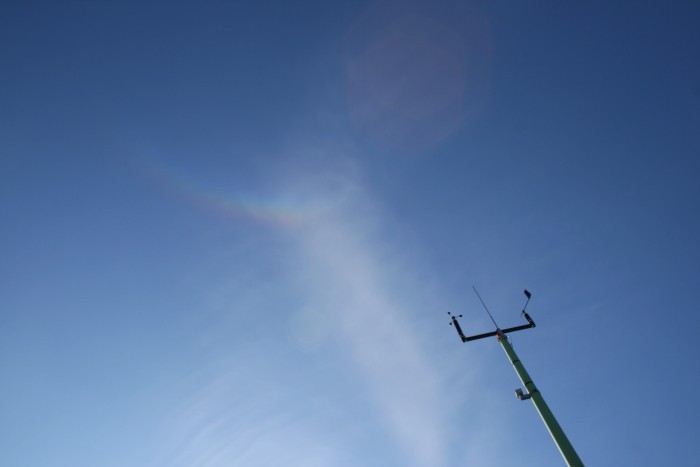
On 23 February an another diamond dust display with odd radius halos occured in Vaala, Finland. Temperature was dropping from -29°C to -24° during my observation.

A parhelic circle and circumzenithal arc were present with nice parhelia. A subsun and subparhelia were also seen as sparkling ice crystals in front of the ground.

Odd radius halos labelled in this enhanced photo are A) a pyramidal heliac arc, B1) upper 24° plate arc, B2) lower 24° plate arc and C) upper 23° plate arc.

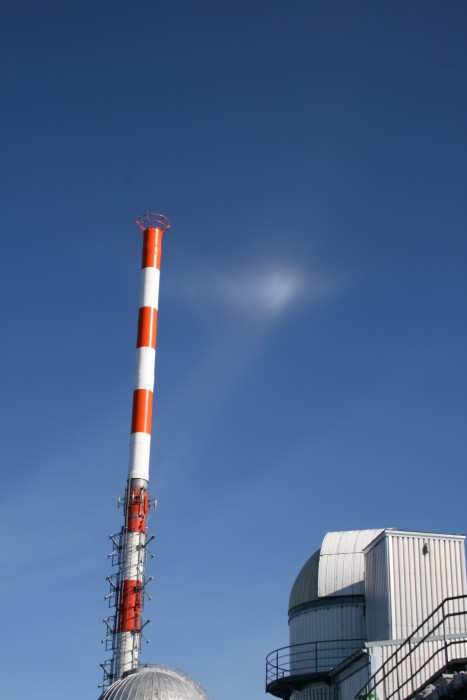
The most brightest odd radius halo was 18° halo and in some photos there probably are also 9° upper plate arc and 20° halo. The ice crystal cloud was produced by a local heating plant about 2 km away. More photos can be found here.

2007. március 5., hétfő

Upper Lowitz arc in Germany


On February 21, Wolfgang Hamburg was on holiday in the Erzgebirge, but rather had snow there. Around noon, the cirrus clouds which already had caused an unusual halo activity in Bavaria (see one thread below), arrived at his position in Mulda. So between 1 and 1.30 pm, Wolfgang Hamburg also observed unusually bright sundogs followed by a beautiful display showing Parry arc and upper Lowitz arc. The enhancement of the unsharp mask shows the arc in the "Chinese eye" formed by the halos.

2007. március 1., csütörtök

Probable fragment of subheliac arc

On February 20 there were a lot of cirrus shreds in the foehn area of a strong northern low pressure area. Already in the morning there appeared unusually bright sundogs and a circumzenithal arc of the same brightness in these cirrus shreds. Later also a Parry arc appeared together with parts of the parhelic circle and very bright 120°-parhelia which had an accentuated reddish rim. At 11.50 CET, another arc seemed to form above the left 120°-sundog which stayed at its position for about 10 minutes while the cirrus clouds kept moving on. As the simulation for a sun elevation of 24° shows, the position of that arc fragment is identical to the subheliac arc.

2007. február 28., szerda

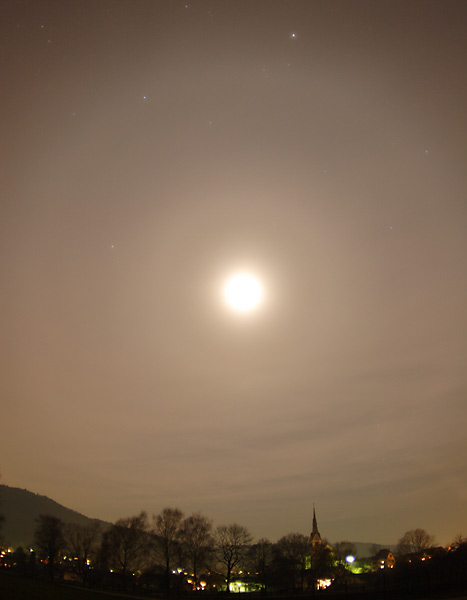
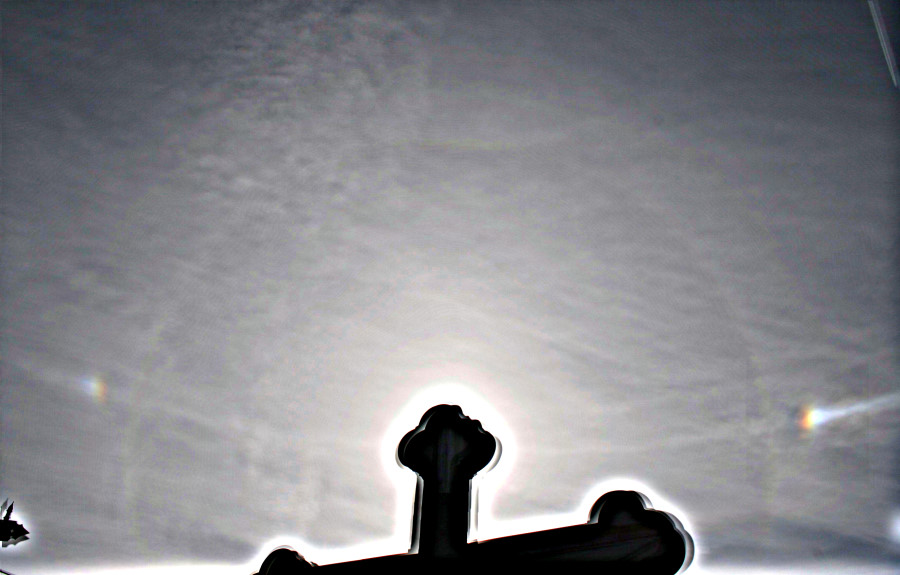
Bright 9° halo around the moon in Germany

On the 23rd of February Harald Wochner took his obligatory view out of the dormer window towards the night sky. Immediately, he realized an unusual circle which later turned out to be a 9° halo around the moon. Right at this moment he took his Camera and tripod and went a couple of hundred meters away from his village in order to have a darker sky. He could also recognize a feeble 22° halo in larger distance from the moon. There one could see the structures a little bit more. The 9° halo maintained itself in a good shape and could partially better be seen than the 22° halo which acted really diffusedly. Which the descending of the moon, the intensity of the circles decreased steadily.

The picture shows the village Wahlwies with its church on the western Lake of Constance. The picture with unsharp mask shows in addition the faint left part of 18° halo.

2007. február 17., szombat

Moilanen arc behaviour


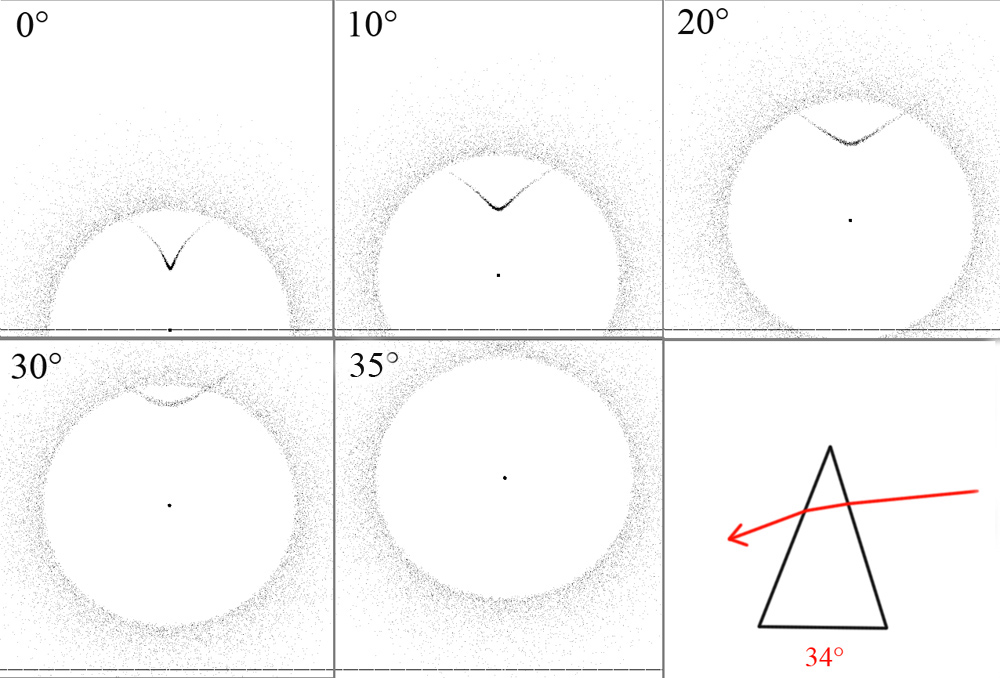
We have now enough photographs of Moilanen arc to make some suppositions of the responsible crystal. As lower component of Moilanen arc does not seem to exist, the crystal must be well oriented. Straight upwards pointing wedge with ~ 34° angle seems to produce an arc that fits well with photographed cases both in shape and location.

In the image above are given simulations of Moilanen arc and 22° halo for solar elevation range of 0-35°. Also the Moilanen arc raypath through the wedge is shown. At 35° light source elevation the Moilanen arc is already disappearing and shows weakly above the 22° halo.

In free fall the depicted simple prism would hardly orient as shown. What kind of crystal causes Moilanen arc is still a mystery. Although Finnish observers have managed to sample crystals from a couple of Moilanen arc displays this winter, the crystal photos have not resulted in a breakthrough.

These images are no news to those who have an inclination to fiddle with halo simulation programs. But as nobody has given them anywhere, I thought they might be of some help for the halo community in knowing what to expect when the next diamond dust swarms in. Simulations are made with software by Mika Sillanpää and Jarmo Moilanen.

Diamond dust display in the Spanish Pyrenees


On January 26, 2007, Claudio Martinez watched and photographed a complex diamond dust halo display at the Baqueira Ski Station in the Spanish Pyrenees. Baqueira is situated at an altitude of 1850m. At about 5.30 pm CET the display showed the 22°-halo with sundogs, anextremely bright upper tangent arc, upper and lower sun pillar and the parhelic circle. Part of these was also visible in front of a mountain ridge. In the upper sun pillar there also appeared the Moilanen arc. Nearby floating ice crystals are also visible as bright sparks in the pictures.

There is also a video existing. You can see it here.

2007. február 9., péntek

Pyramidal heliac arc in Finland

I

In 8 Feb 2007 an odd radius display was produced by local heating plant plumes in -28°C temperature in Vaala, northern Finland. I photographed this display on a road about 1.5 km away from the heating plant.

Odd radius halos in display were 18° halo, 23° upper plate arc, very faint 35° halo and rare pyramidal heliac arc. See arrows in a stacked and strongly unsharp masked photo shown.

Pyramidal heliac arc is formed by reflection from pyramidal side faces of horizontally oriented pyramidal ice crystal. It is usually visible near the sun only. It is usually very faint but this time I was able to see it also visually.

Same odd radius halos except 35° halo were also present in similar but much fainter display in Vaala couple of days earlier in 6 Feb 2007. More photos from both displays can be seen in Jarmo Moilanen's halo photo gallery or directly 8 Feb. 2007 here and 6. Feb 2007 here.