2006. szeptember 18., hétfő

Lowitz arcs in Czech

Martin Popek observed this display with Lowitz acrs on 16. September. Interesting feature is the lower Lowitz component extension above parhelion. In the simulation there is something like that, but it's very, very ghostly. The main body of the lower component below parhelion looks as if it were just a patch of 22° halo - the extension towards parhelion is missing. Same goes with the upper component. This is quite typical way of Lowitz arcs showing up. Circular component is seen only above parhelion.

I was given sun elevation of 39° for this display but somewhat lower elevation gave a bit better simulation results. This is for 33°. The projection in the simulation is clearly not the same as in camera and this may have caused some of the broblems. Simulation is made with Halosim by Les Cowley and Michael Schroeder.

Be the sun elevation 39° or 33°, it does not change much anything fundamentally. Several question could be raised about this display with lenghty discussions. It seems we still have a long way to understanding Lowitz arcs.

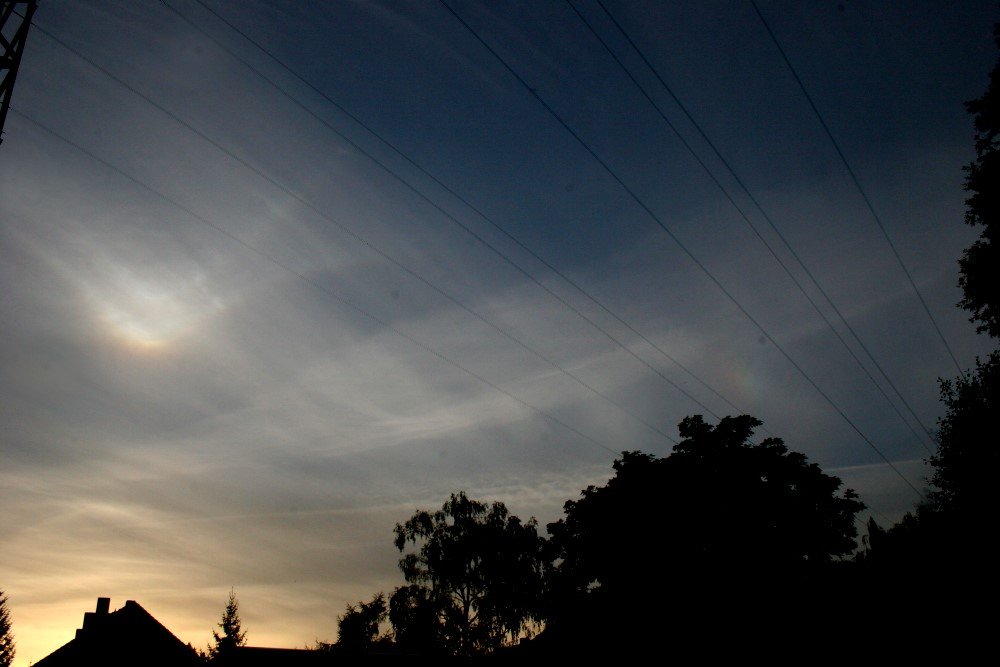
V-shaped Parry and Tape's arc in Germany

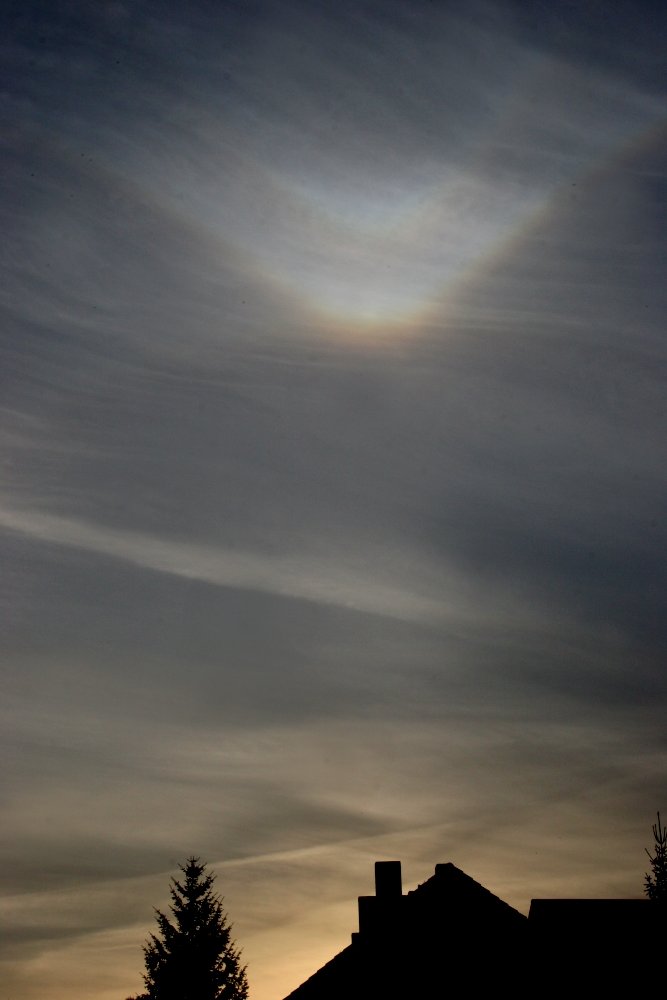
On August 31, 2006, clouds moved in destroying all hopes for meteor observations in the night. The halo display in the high clouds close to sunset (1725 UT, Sun elevation approximately 3 deg) observed by Jürgen Rendtel from Marquardt (west of Berlin, 13.0 deg E, 52.5 deg N) included intense V-shaped upper tangent and Parry arcs. Another bright coloured 'spot' of about 3 deg apparent size was found to be part of the supralateral arc and Tape's halo. The image processing by Claudia Hinz using unsharp masking also revealed the convex Parry arc.

2006. szeptember 16., szombat

Circumscribed halo and pyramid halos in Sardinia


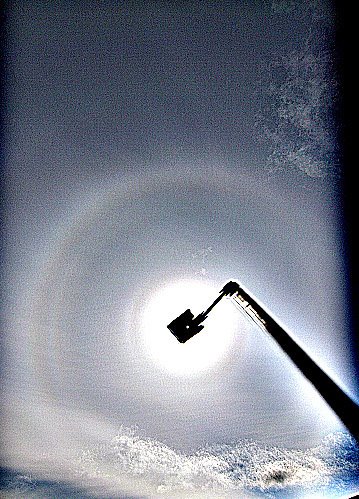
This display was captured by Jan Drahokoupil in Sardinia on 6. September. The 22° halo is surrounded by elliptical circumscribed halo. The small halo around the sun is 9° halo or 9° column arc (or both together). Simulations could give better clue. Later on the display changed and there were also 18° plate arcs.

More photos here.

2006. szeptember 14., csütörtök

A fine circumhorizontal arc from Italy


Circumhorizontal arc more than 100° wide above the horizon, very brilliant, for about 25 minutes. The best I have seen from Italy!

Equipment :Canon EOS D30.

A collage of 3 images with a 35mm lens at f/8 and 1/1000 sec. 

31 May 2006 12,20 LT (+2h) Viterbo - Italy

2006. szeptember 9., szombat

Odd radii in Czech

During the Czech halo observers meeting in Kuncice, high clouds created some good displays. This odd radius halo complex was seen on 14. August. It shows 9,° 18°, 20°, 22-24° and 35° halos. Judging from the non-uniform intensity distribution of some of the halos (9° and 20° halos being brightest on the sides), this display was caused by poorly oriented columnar pyramid crystals. It's also interesting that 20° halo is brighter than 18° halo. This type of occurence is uncommon.

This is stacked image processed by Roman Manak and Patrik Trncak. Original photos were taken by Martin Popek.

2006. augusztus 16., szerda

HOP meeting 13 - 16 August 2006

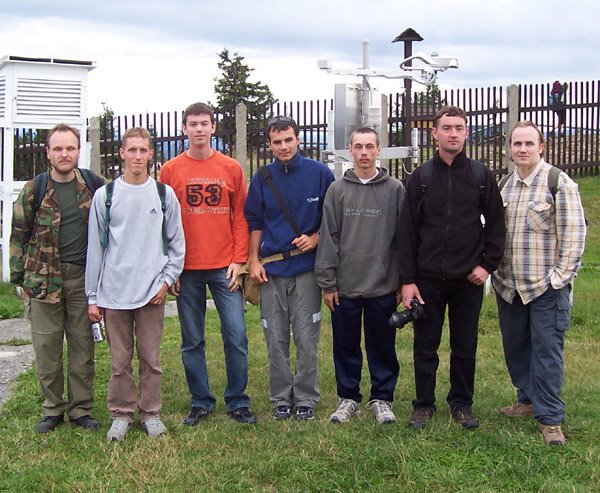
Meeting of Halo Observation Project members was in Kuncice pod Ondrejnikem (Czech republic) - beautiful landscape of hills and woods. We had very nice observations of some rare halos: Parry suncave arc, 9 halos and 18 halos, on the high clouds. See PHOTO from Martin Popek. On photo from left to right: Vladimir Odvarka, Roman Manak, Lukas Kosarek, Jan Kondziolka, Martin Jankovic, Martin Popek and me. Photo was taken on meteorological station, Lysa hora.

2006. augusztus 14., hétfő

Subhorizon diffuse arcs with Liljequist subparhelia

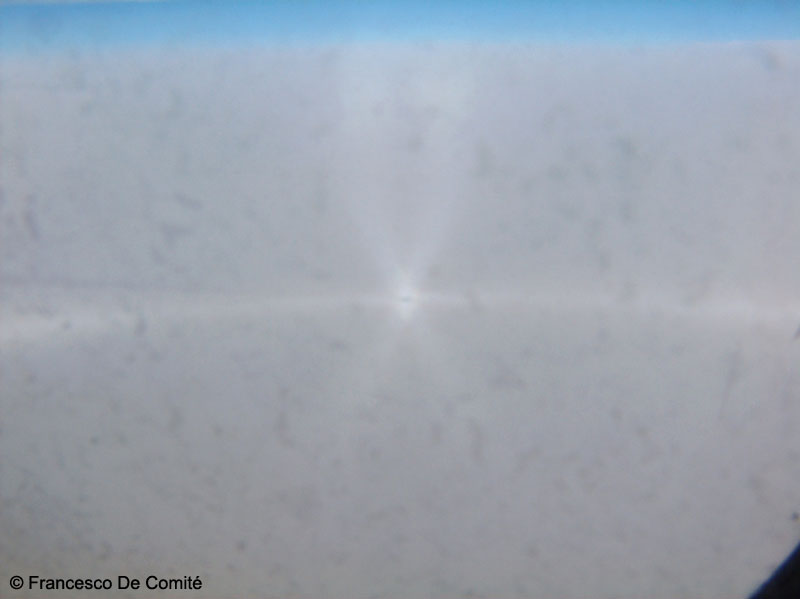
Francesco De Comité took this great photo from an airplane between Brussels and Madrid in 7 August 2006 at 19h31. Unfortunately no more additional photos are available from this display.

There is really well developed diffuse anthelic arcs crossing subparhelic circle. Subanthelion point is illuminated by these arcs. In this case it is clear that there is no subanthelion, since bright spot on subanthelion point has clearly square shape caused by diffuse arcs. Column ice crystals have to have good orientation.

Other very rare halo shown in this photo is broader segments on parhelic circle on both sides on subanthelion point. Unfortunately these broader segments are not very clear and they are cutted by edges of the photo. These broader brightenings are so called Liljequist subparhelia caused by plate ice crystals. Liljequist subparhelia have been photographed earlier at least by Walter Tape (see Tape's book Atmospheric Halos in page 71). Tape's display is very similar than this Francesco's display.

Since Francesco's display has rare halo made by plate ice crystals, it would be a really good case to look for still undocumented 120° subparhelia. Hunt for 120° subparhelia is still going on...