2006. július 23., vasárnap

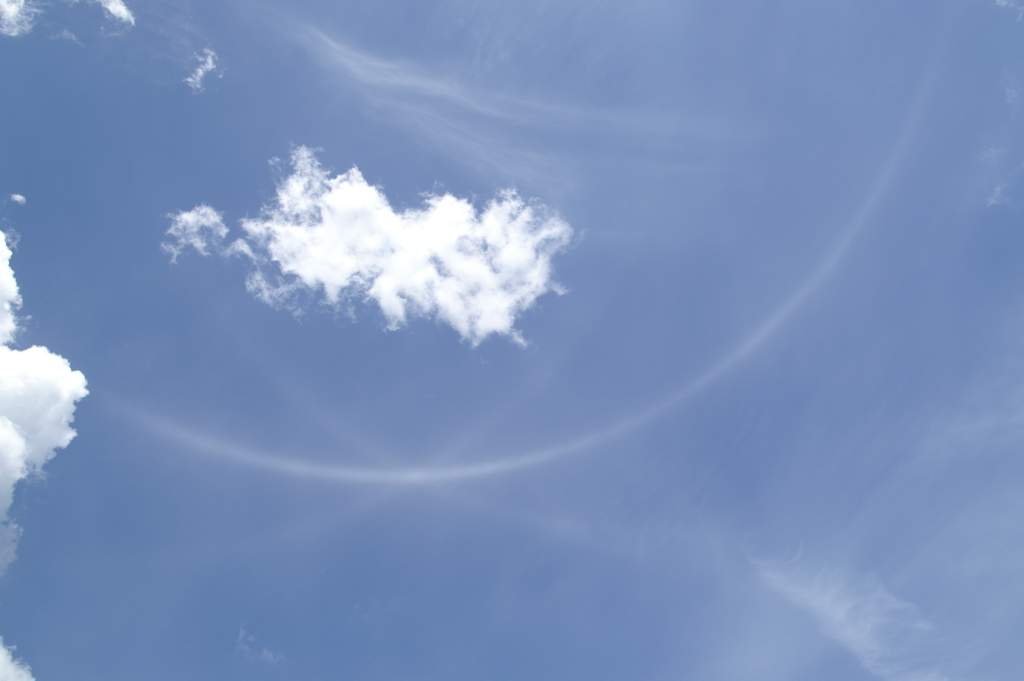
Subparhelic circle


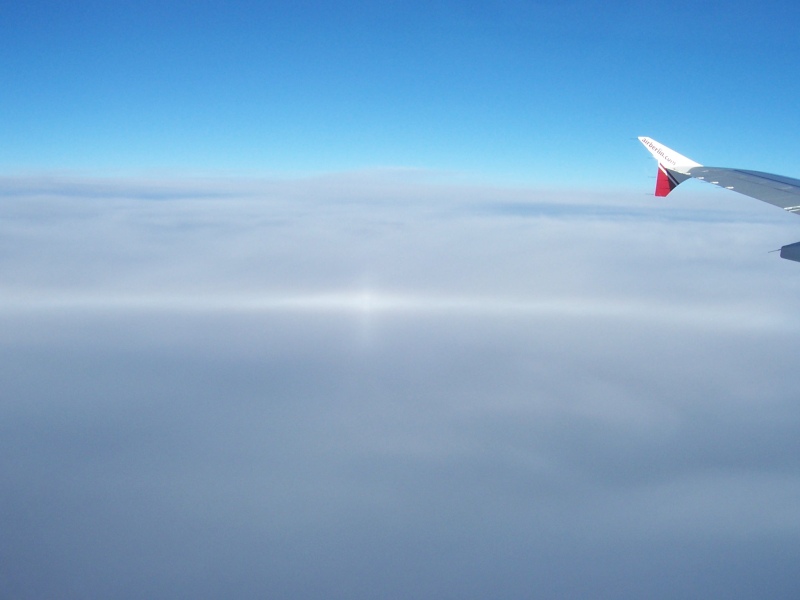
On June/3/2006 at 20:20 CEST Susanne Danßmann observed a subparhelic circle on a flight from Berlin to Zurich. The elongated spot of light in the center of the image is likely a subanthelion. The shadow on the winglet suggests the photo was taken in direction of the antisolar point. There is no shadow of the airplane in the center of the subanthelion, because the airplane was high above the clouds.

2006. július 17., hétfő

Halo Meeting in Finland 14-16 July 2006

Nearly thirty halo enthusiasts from all around the world gathered to Artjärvi, Finland for a weekend of avid halo discussion. Apart from Finland there were participants from the USA, Japan, Germany, Sweden, Czech Republic and Netherlands. The meeting took place in URSA Astronomical Association's new observation centre. The programme for the meeting consisted of five sessions that included 14 presentations. The topics spanned from halo theory and simulation to photography and observation techniques as well as national observation networks and great historical displays. Slideshows of the very best photographs took place in the evenings and everybody feasted their eyes on literally hundreds of gorgeous halo images.

The event was well organised and everybody appeared to be having a good time. The exciting presentations, friendly atmosphere and the evening gatherings around the campfire all added to a great experience of shared enthusiasm. And to top it all of, beautiful NLC displays illuminated the skies on both nights.

We are all indebted to the people who dealt with the groundwork: Veikko, Marko and Jukka worked hard on all the arrangements while Krista and Aikku prepared the delicious meals. As soon as the gathering came to an end the plans for a new meeting had already started brewing among the participants.
2006. június 9., péntek

Wegener anthelic arcs in Ondrejov

Two days (8.6.2006 and 9.6.2006) in Prague and near neighbourhood was very good for halos. The best halo display had Martin Nekola in Ondrejov, he was seen nice Wegener arcs in high Sun elevation (approximately 55 degrees) as big X on anthelion side of Sun. Web site of some next Martin´s halo photos is here.

2006. május 19., péntek

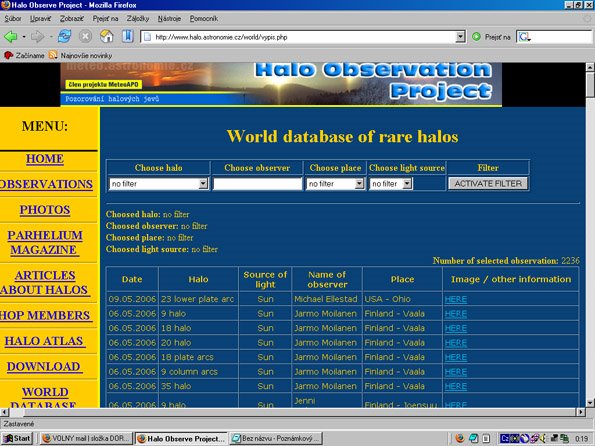
World database of rare halos

For all rare halos of the world is database now. The most contribution to database is from Finnish, Czech and German observing networks, and from acouple of active observers from USA. You can search the database in four ways: all observations, name of observer, country of observation and name of halo.


You visit: http://www.halo.astronomie.cz/database.php

Bottlinger's rings from airplane

To help overcome our dearth of haloes, here is another archive picture. It was taken in the morning over Iberian Peninsula in April 1997 by Frank Wächter using a 35mm lens. It shows elliptical haloes around the subsun called Bottlinger's rings.

2006. május 18., csütörtök

A halo caused by light reflected from water surface

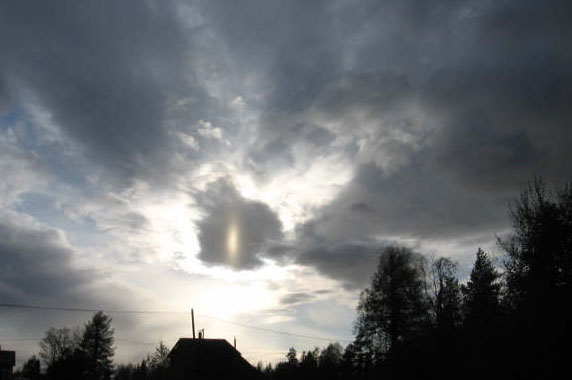
This subsun-like pillar on front of dark cloud was photographed by Jenni Elina Holopainen on 18. May 2006 in Pyytivaara, Finland. The position of the pillar is apparently the same as that of the Sun's behind the cloud, which is better revealed by the cloud rays in another photo.

So how this is possible? The explanation must be a reflection of sun light from still water body and further reflection of this light from ice crystals that are precipitating from the Altocumulus clouds seen in the picture. Thus we are looking here - not at the subsun - but at "supersun".

The best sun pillars are usually seen in the icy virga of the Altocumulus clouds. This is because virga can consist of very big plate crystals that have plenty of horizontal surface to reflect sun light. Thus it would be expected that if this phenomenon were to occur, it would be Ac virga if anything. In high clouds it's impossible to see this, becase there is nothing behind the crystals to block the Sun. And when diamond dust occurs, waters are usually frozen. Thus ice crystals precipitating from middle level clouds is perhaps the only possible formation for the phenomenon Holopainen photographed. In yet another photo taken by Holopainen, a curved Ac virga can be seen in the middle of the picture above the lake. This is the lake that most likely was responsible for the reflection.

Actually this is not the first observation we have of this kind of phenomenon. In the end of 90's in Oulu a pillar of light (with no distinct subsun like appearance) was observed in a similar manner.

2006. május 14., vasárnap

odd radius plate arcs


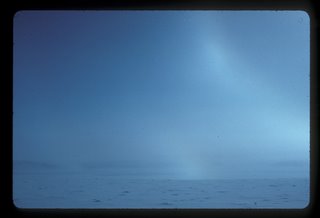
35° plate arc in lower center, 24° plate arc above it and slightly to the right, and faint infralateral arc (?) at far left. The angular distances from the sun still need to be measured, however. Dalton Highway, northern Alaska, April 17, 2006. The photo has not been manipulated. Copyright Walt Tape.

A wider angle photo of the same display is here. A photo of another display, about 20 minutes earlier and ten miles further south on the highway is here; (then at "on assignment: arctic Alaska").